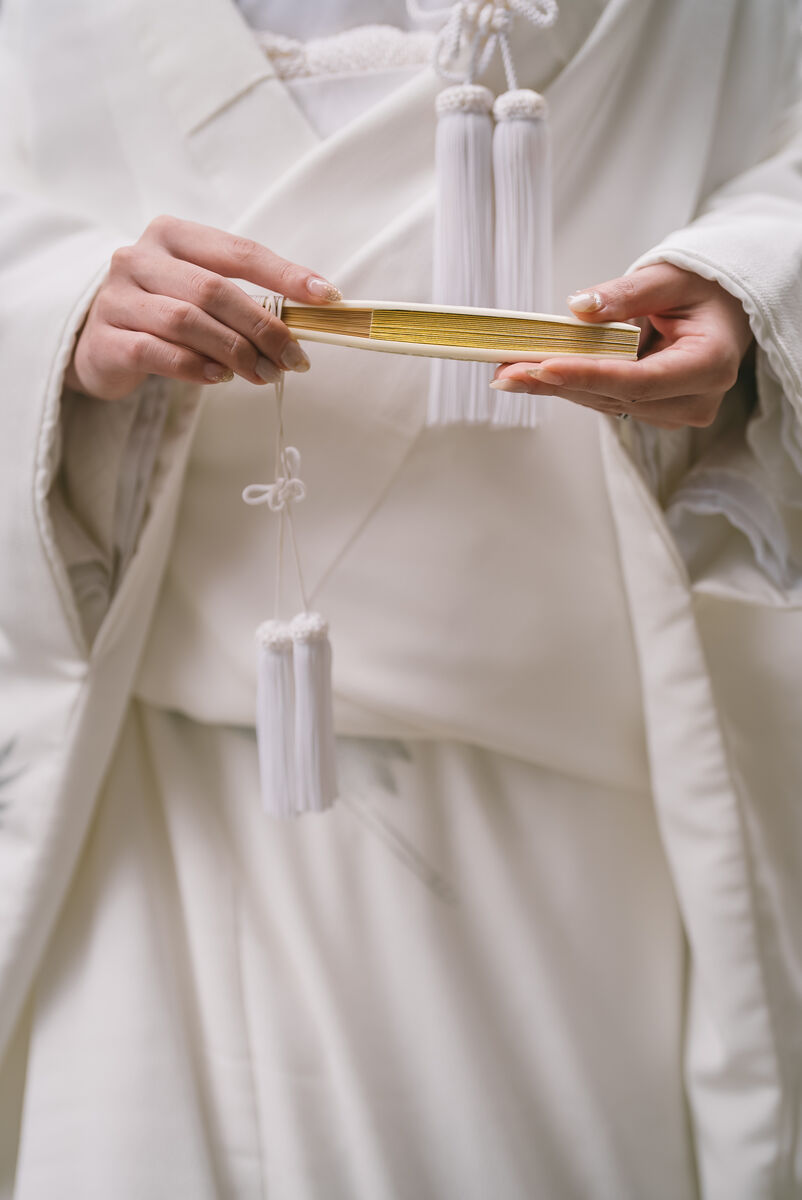
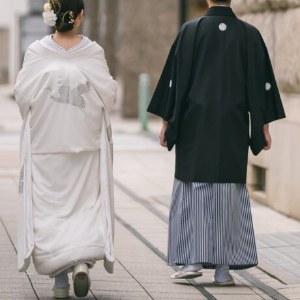
There’s a ¥1,000 line on our wedding photoshoot invoice that says “mizuhiki styling.” It’s the smallest number on the bill and one of our favorite details in the photos: a knot of stiff paper cord, tied into the bride’s look. Below is what mizuhiki is, why the knots have meanings, and why it might be the best small souvenir in Japan.
Paper you can tie
Mizuhiki (水引) is cord made from twisted washi paper, stiffened with glue, and wrapped in colored thread or foil. It has been used to bind gifts since at least the Muromachi period, and the binding counts as part of the gift: it shows that something was prepared with care and has not been opened.
If you’ve ever received a Japanese money envelope, you’ve handled mizuhiki. Those red-and-white or gold-and-silver cords across the front work more like grammar than decoration.
The knots have meanings
- Musubi-kiri (結び切り): a flat, tight knot that cannot be retied. Used for events that should happen once: weddings, recovery from illness. The knot can’t be untied, so the event shouldn’t repeat.
- Chō-musubi (蝶結び): the bow, easily retied. For happy events you’d gladly repeat: births, promotions, new years. Never use it on a wedding envelope.
- Awaji-musubi (あわじ結び): an interlocked knot that gets tighter the more you pull each end. It is the usual choice for weddings, because the harder life pulls, the stronger the bond. It is also a very pretty knot.
Colors carry meaning too: red-and-white for celebrations, gold-and-silver for weddings, black-and-white only for funerals. Check this before you grab any envelope off a convenience-store shelf. (Full envelope etiquette is in our Japanese wedding guest guide.)
Our ¥1,000 story
For our kimono pre-wedding shoot, we brought our own mizuhiki cords, and the studio’s stylist worked them into the styling for a ¥1,000 fee. It’s a small example of something we love about Japanese wedding culture: there is room for personal touches, and professionals will meet you halfway if you bring one.
Mizuhiki as modern craft (and souvenir)
Mizuhiki has become a contemporary craft too. Artisans (the most famous center is Iida in Nagano, which produces the majority of Japan’s mizuhiki) now make earrings, brooches, chopstick rests and ornaments from the same knots.
As a souvenir it’s close to perfect: it weighs nothing, doesn’t break, fits flat in a carry-on, and comes with a story you now know how to tell. Look for it in craft shops, department-store stationery floors, and the gift corners of nicer bookstores. Awaji-knot earrings are easy to find in gift shops; the price depends on the maker.
And next time you hand someone a gift envelope in Japan, check the knot. Along with the money, the cord is saying: may this happen only once.
Part of our Kimono & Japanese Weddings series, written from our own wedding preparations in Nagoya.