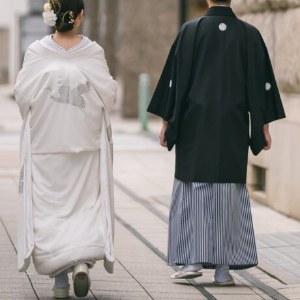
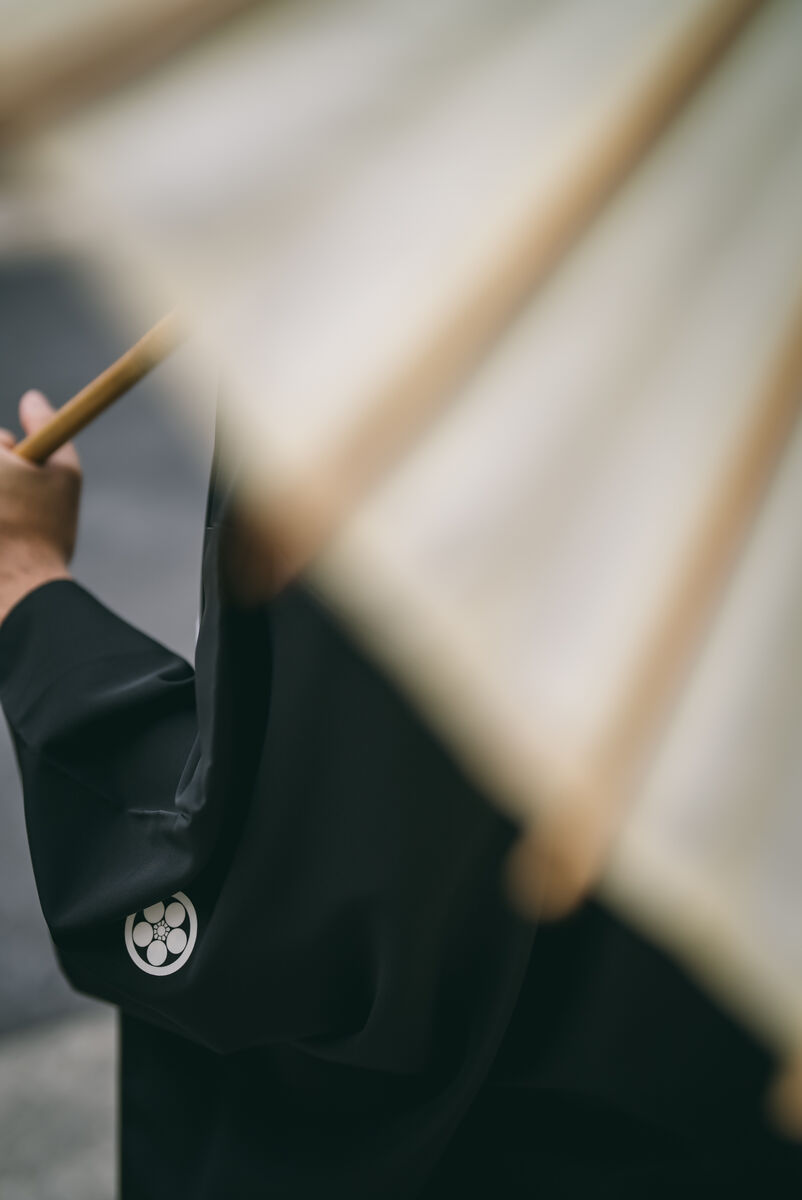
Look closely at a formal black kimono in Japan and you’ll find a small white emblem on the chest, the sleeves and the back. It looks like a logo, and in a way it is: a kamon (家紋), a family crest. Almost every Japanese family has one, including us.
A thousand years of family logos
Kamon began around the Heian period (794–1185), when aristocrats marked their ox-carts and belongings with elegant patterns to say this one is ours. Samurai took the idea to the battlefield. Banners and armor needed to be readable at a distance, which is why crests are bold, circular and high-contrast. By the Edo period (1603–1868), commoners had adopted them too. Merchants used them as shop marks, and ordinary families wore them on formal wear.
The result: an estimated tens of thousands of crest designs, almost all of them monochrome, geometric and surprisingly modern-looking. Wisteria, cranes, ginkgo leaves, arrows and sailing ships were turned into simple circles centuries before anyone talked about “flat design.”
Does every family really have one?
Mostly, yes, though many young Japanese people couldn’t tell you theirs off the top of their head. The crest usually passes down the family line, and it comes out at formal moments: weddings, funerals, family graves (look for crests carved into headstones), and the montsuki, the crested formal kimono. The most formal version carries five crests: back, both sleeves, both chest panels.
How do people find theirs? Usually you ask your grandparents, then check the family grave, then check old formal kimono or funeral records. That’s what we did before our photoshoot.
Why we paid ¥10,000 for ours
When we did our kimono pre-wedding photoshoot in Kobe, the rental montsuki came with a generic crest by default. Most rentals do, and no guest would ever notice. Specifying our actual family crest was a ¥10,000 add-on.
We paid it, and it’s our favorite line on the whole invoice. The kimono was a rental, but the crest made it ours: the same mark as on the family grave, in a photo for the next generation’s wall. If you ever do a formal kimono shoot and your family has Japanese roots, ask about this option. If not, you’ll wear a “common” crest, which is also fine. That tradition of shared crests (tsūmon) is centuries old itself.
Where travelers can spot kamon
- Noren curtains and shop signs: old shops in Kyoto, Kanazawa and Nagoya still use founder crests as logos
- Temple and shrine roofs: look up for crests of patron families and the imperial chrysanthemum
- Castle gates: the Tokugawa hollyhock at Nagoya Castle is probably Japan’s most famous logo
- Weddings and formal photos: every montsuki you see carries someone’s family crest
- Souvenirs: furoshiki cloths, tenugui towels and sake cups with crest patterns make meaningful gifts
Once you know what kamon are, you’ll see them everywhere: a thousand-year-old system of family marks, right in front of you.
Part of our Kimono & Japanese Weddings series, written from our own experiences. Start with the story (and the receipt): our kimono pre-wedding photoshoot.