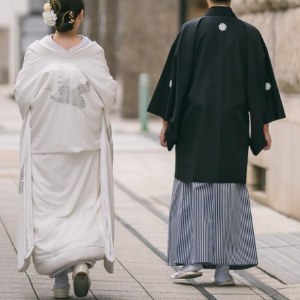
Japanese food that started as a copy of Western food, served inside the station you were only passing through.
Cost: ¥2,090 for a single dish · ¥3,850 for the plate with everything on it
Where: JR Central Towers 12F, inside Nagoya Station itself
Hardest part: finding the lift. The restaurant floor sits above the department store
1. This is where yōshoku comes from. The actual company that started it, trading since 1902
2. Order the Hanatsubaki Plate, ¥3,850. Prawn fry, meat croquette, hamburg and chicken rice on one plate, so you try the whole genre in one order
3. It is inside Nagoya Station. You can do this in a Shinkansen transfer window and never step outside
Most visitors eat a certain kind of Japanese food without knowing it has a name.
Curry that is nothing like Indian curry. An omelette folded around ketchup rice. A hamburger patty with no bun, under brown sauce. Deep-fried prawns as long as your hand. Croquettes.
The word is yōshoku (洋食), literally “Western food”. It is not Western food. It is what happened when Japanese cooks in the early 1900s were handed European recipes and Japanese ingredients and told to work it out, and it has been drifting away from its source for a hundred and twenty years since. It is now entirely its own cuisine, and it is what people here eat when they want to be comforted.
The original is at one address in Ginza. There is also a branch inside Nagoya Station, which is much easier to get to.
A cosmetics company started it, more or less by accident
Shiseido is a cosmetics company, and you have probably seen its counters in airports. Fewer people know that Shiseido began as a pharmacy in Ginza, and that its founder came home from the 1900 Paris Exposition by way of America with an idea that had nothing to do with either.
He had seen American drugstores, where one corner of the shop sold fizzy drinks and ice cream. In 1902 he built one into his pharmacy: Japan’s first soda fountain.
He did not make do with local copies. The machinery, glasses, straws, spoons and syrup were all shipped in from America, because if he was going to do it, he wanted the real version. Geisha from the Shinbashi district became regulars. By 1928 the soda counter had grown into a full restaurant.
Two things came from that, and both are still on the menu. The ice cream soda in Japan starts here. So does a certain idea of how Western food should taste after a Japanese kitchen has worked on it.
The plate that explains the whole cuisine
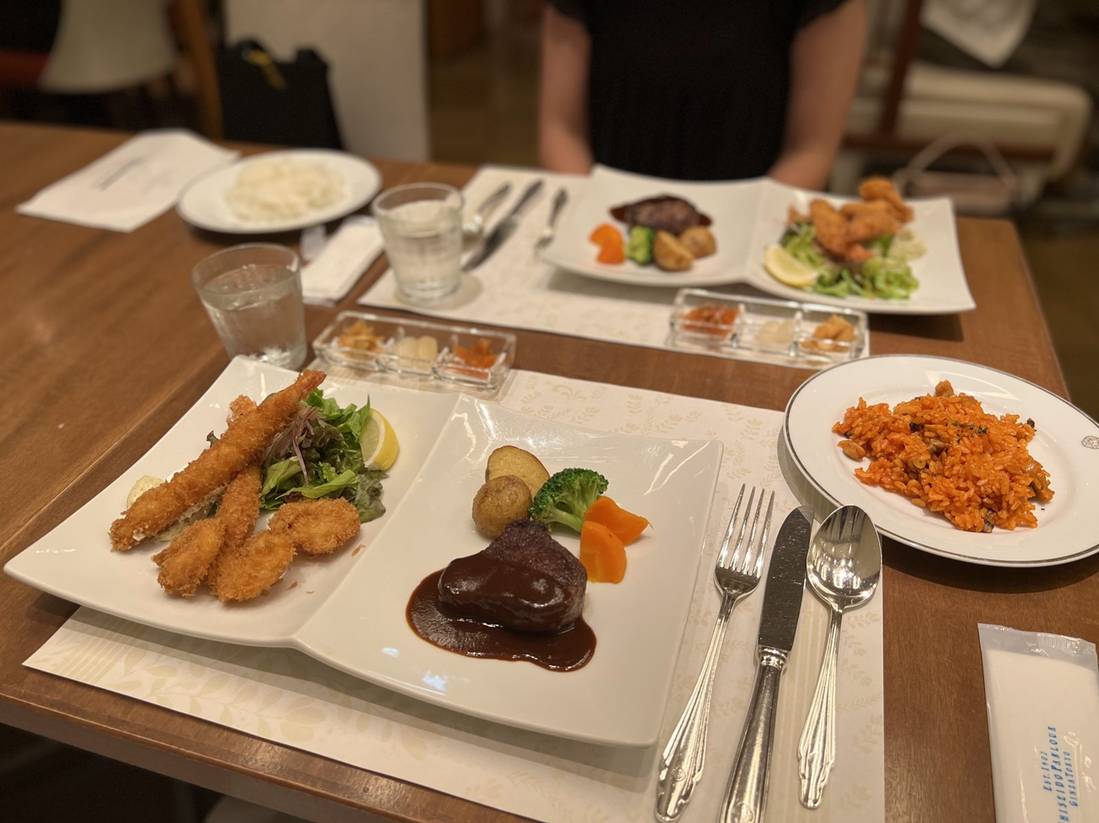
Order one dish and you learn one thing. Order the Hanatsubaki Plate (¥3,850) and you get four of the founding dishes of yōshoku on one long plate. You learn more from that than from reading about it.
What arrives:
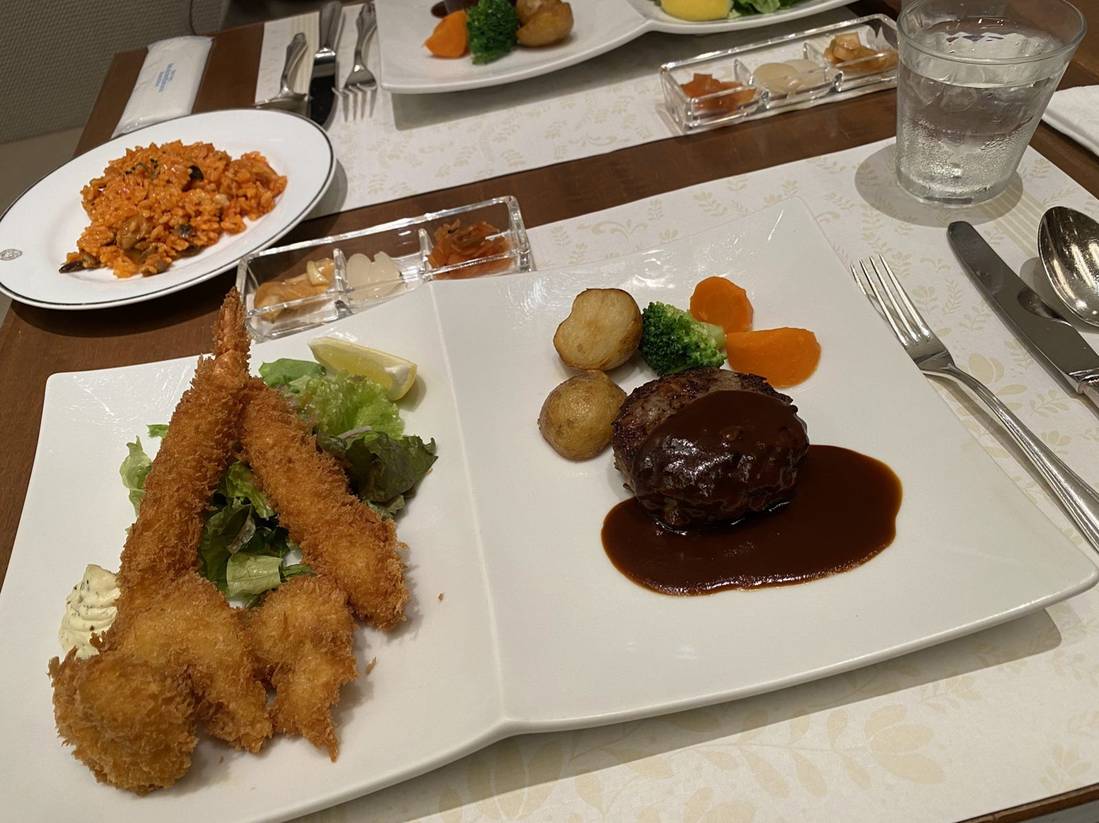
- Ebi fry (prawns in fine breadcrumbs, with tartare sauce and a salad). Bigger than you expect, and crunchier
- Meat croquette in tomato sauce is the dish this restaurant is most known for. It is made with minced beef rather than potato, and is much richer
- Hamburg under brown sauce, with a few boiled vegetables arranged around it. You can pay ¥1,320 more to swap this for a domestic beef fillet steak, and you should not
- Chicken rice is the orange one: rice fried with chicken and tomato. This is the filling that goes inside an omurice, served on its own
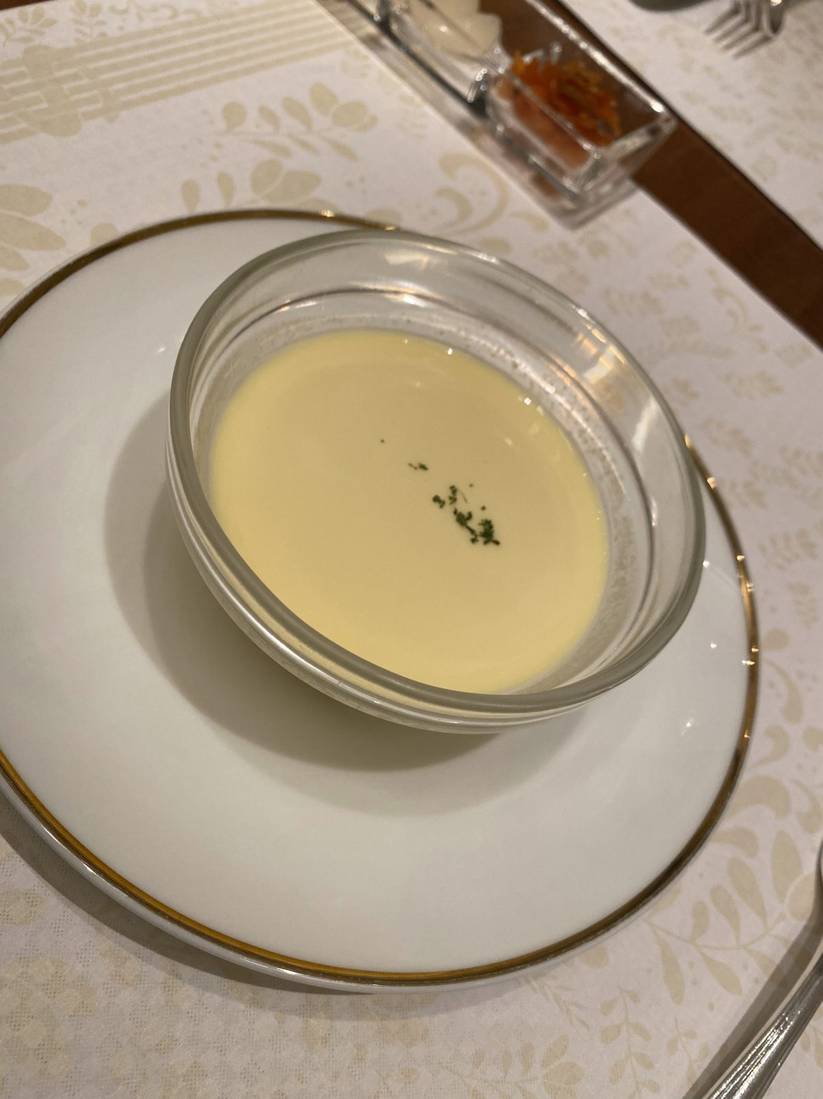
- A soup, and coffee or tea afterwards
The vegetables come in small separate glass dishes, the tablecloth has a woven pattern, and the water glass is heavy. None of it is meant as a joke. The restaurant has done things this way since before the war and has not changed the parts that work.
what Japanese connoisseurs know
The chicken rice is the clue. If you have eaten omurice in Japan and wondered what was inside, this is it, without the egg. People ate it on its own before somebody thought of wrapping it in egg, and it is still on the menu at ¥2,090, seventy years after the omelette version overtook it.
What everything costs
From the restaurant’s own menu, checked August 2026. All prices include tax.
| Hanatsubaki Plate (the four-dish plate) | ¥3,850 |
| Omurice | ¥2,530 |
| Meat croquette, Shiseido Parlour style | ¥2,310 |
| Beef curry rice · seafood curry rice | ¥2,420 |
| Chicken rice | ¥2,090 |
| Small prawn and mushroom doria | ¥2,200 |
| Seafood macaroni gratin, tomato sauce | ¥2,090 |
| Seasonal fruit parfait | ¥2,640–2,860 |
| Kids’ plate (primary school and under) | ¥1,870 |
| Weekday lunch plate, 11:00–14:00 (Nagoya only) | ¥3,080 |
It is not cheap. A bowl of ramen two floors down in the same station is ¥890. Here you pay for a kitchen that has cooked the same six dishes for a century, and a dining room that still feels like 1955.
Save room, because the parfait is the other reason to come
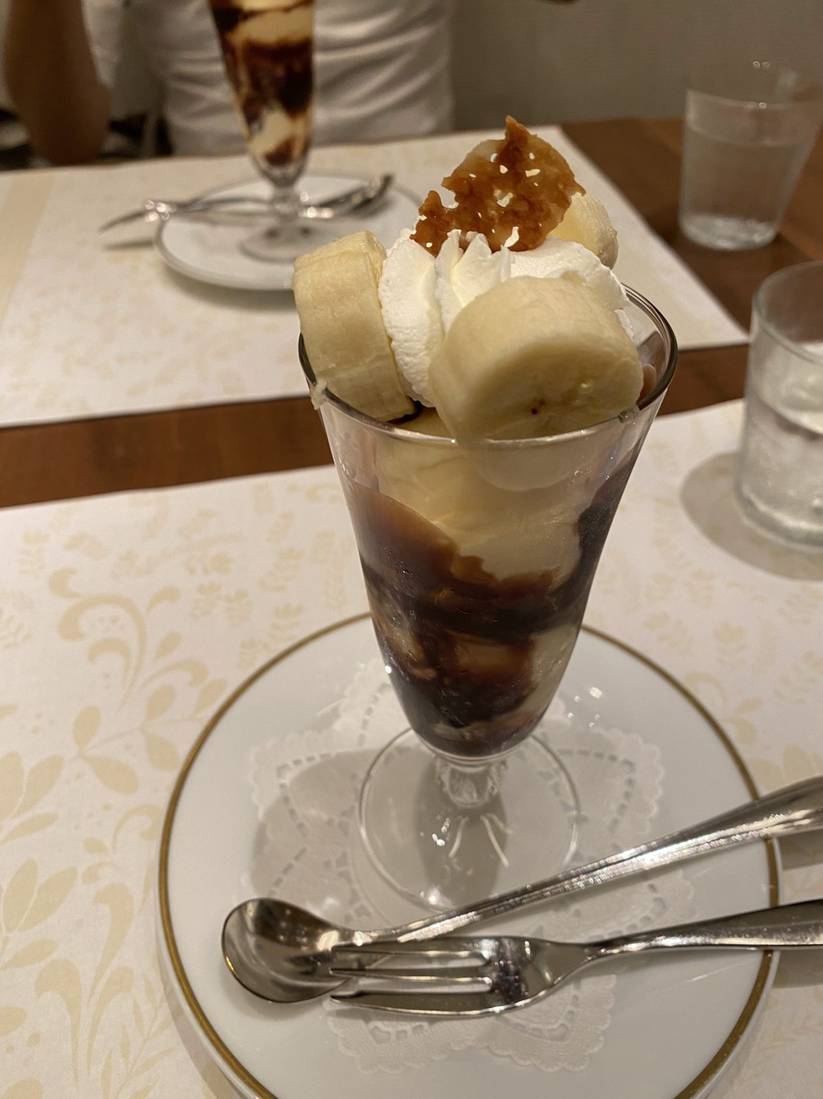
The company began by importing an ice cream machine, and it still takes desserts seriously. You can see it in the seasonal parfaits. They are built in layers in tall glasses (sorbet, ice cream, jelly, the fruit itself) and change with the season, which in Japan means they change all the time.
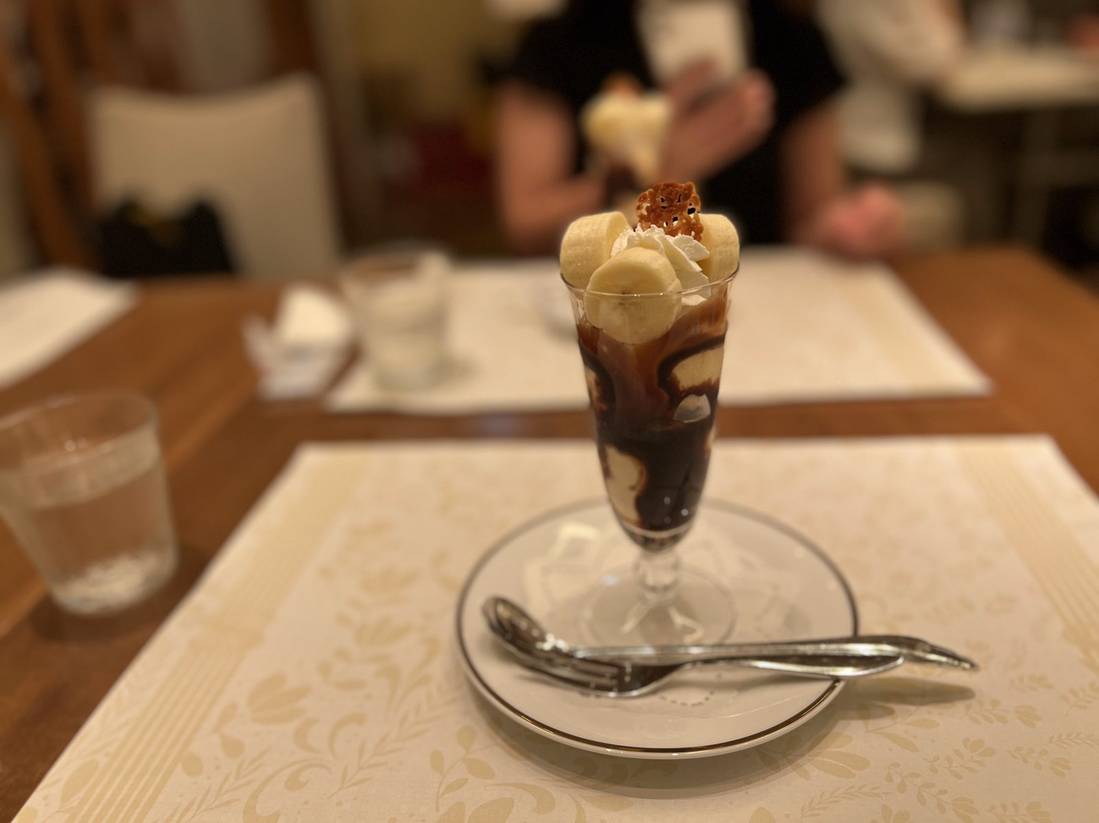
The one we had was a banana parfait: banana, chocolate sauce, whipped cream, and a shard of caramel brittle standing upright out of the top of it. It arrives with a long spoon and a doily under the plate.
Order whichever one is on when you go. For two people, sharing a main and having a parfait each is the right way to do it.
Getting there without leaving the station
Plan around the location. The restaurant is on the 12th floor of JR Central Towers, the building right on top of Nagoya Station, so you never go outside or cross a road.
- Address: 1-1-4 Meieki, Nakamura-ku, Nagoya, JR Central Towers 12F
- Open: 11:00–22:00, last orders 21:30 (courses 21:00). Closed only when the building is
- Reservations: dinner only; they take none for lunch. Weekdays 17:00–20:30, weekends and holidays 18:00–20:30
- Phone: 052-588-2240
Follow the signs for the Towers Plaza restaurant floors, 12 and 13. The lifts you want are past the department store rather than inside it, which is the only confusing part.
If you are on a Shinkansen transfer: ninety minutes is enough for a main and a coffee. Two hours is enough to do it properly. There are coin lockers on the concourse below you, so the suitcase is not a problem.
Ginza or Nagoya?
The Ginza building is the original and a bigger outing: a whole building over several floors, with a salon de café on the third floor just for parfaits. If you are in Tokyo with a free afternoon and want the full version, go there.
But most people reading this will pass through Nagoya Station and never through Ginza. The kitchen is the same company, the traditional dishes are the same dishes, and you can be seated eleven minutes after getting off a train.
The Nagoya branch also has things Ginza does not: a weekday lunch plate, a dressed omurice on weekday evenings, and dishes made with Aichi pork. So even the Ginza original changed a little when it moved to our area.
FAQ
Is there an English menu?
The company runs an English site, and the restaurant is inside a station complex used by international travellers all day. Ask at the desk. If that does not work, everything on this page is on the menu by name, and you can always point at a photo.
Do I need to book?
Not for lunch. They do not take lunch bookings at all. For dinner you can reserve, and on a Saturday evening you probably should.
Is this a good place to bring children?
Yes. There is a kids’ plate at ¥1,870 and a kids’ parfait at ¥1,100, both for primary school age and under. The room is formal, but nobody expects you to be silent.
What is the one thing to order if I only have one?
The meat croquette, ¥2,310. It is the dish the restaurant is known for, and it is completely different from the potato croquette sold in every supermarket in the country.
Is yōshoku the same as fusion food?
No. Fusion is done on purpose. Yōshoku came from a hundred and twenty years of Japanese cooks slowly adjusting foreign recipes, without anyone trying to invent a new cuisine. Nobody here thinks of curry rice as foreign food any more.
• JR Central Towers 12F, inside Nagoya Station · 11:00–22:00 (L.O. 21:30)
• Hanatsubaki Plate ¥3,850 (prawn fry, meat croquette, hamburg, chicken rice, soup, coffee)
• One dish only? Meat croquette ¥2,310
• Seasonal parfait ¥2,640–2,860 · kids’ plate ¥1,870
• No lunch reservations · dinner reservations from 17:00 on weekdays
• Trading since 1902 (Japan’s first soda fountain, in the corner of a Ginza pharmacy)
• Prices from the restaurant’s own menu, checked August 2026 · nobody paid us anything · the two booking links near the end of this page are affiliate links
More from the same station: tonkotsu ramen two floors below, ¥890, why a coffee here comes with breakfast attached, and where to put the suitcase first.
About us · Contact · Privacy Policy · Disclosure
Affiliate links: if you book through them we may earn a small commission, at no extra cost to you.
Planning the trip
Coming to Nagoya? These guides cover the rest of the trip, with prices we paid or checked ourselves.
- Shinkansen prices from Nagoya: what we paid to Tokyo, Osaka and Kyoto →
- Ghibli Park tickets and access: a Nagoya local’s guide →
- Nagoya airport to Nagoya Station: ¥980 by train, 29 minutes →
- Where to stay in Japan: business hotel, ryokan or capsule →
- Getting online in Japan: eSIM and pocket WiFi, real 2026 prices →