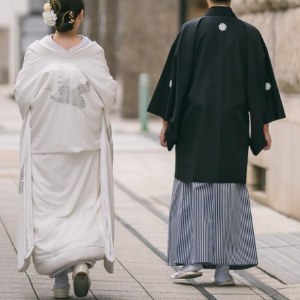
My husband is from Fukuoka and I am from Nagoya. This is his ramen, ordered the way he orders it, in my city, and you will not have to say a word.
Cost: standard bowl ¥890 · the set we ordered ¥1,190 · second helping of noodles ¥110
Where: Dai Nagoya Building B1F, underground the whole way from Nagoya Station
The catch: none. You order from a screen, and the only decision is how firm you want the noodles
Have you heard of tonkotsu ramen?
If you are reading this, you probably already have. Maybe you have seen the bowl: milk-white soup, thin straight noodles, a slice of pork on top. Or someone told you it was the one you had to try in Japan.
They were right.
Tonkotsu is pork bones, boiled hard for hours until the fat breaks apart and turns the water opaque. It is thicker than most soups and coats your mouth. The richness is hard to describe until the bowl is in front of you, and it is the reason people who visit Japan once come back for another bowl.
My husband is from Fukuoka, where this soup was invented. He ate it for the first twenty-two years of his life. Never at home, because nobody makes this at home. He ate it in the shops near school, near work, and on the way back from anywhere. He thinks anyone who comes to Japan has to eat this. He says “have to”, not “should”.
The problem is location. Real Hakata tonkotsu is from Fukuoka, on the island of Kyushu, five hours from Tokyo by bullet train, and most people’s route does not go there. Flying down for one bowl is a lot to ask.
So this page is about the other option: eating it properly, somewhere you were going anyway.
We found a Hakata-style shop in the basement next to Nagoya Station. He ordered exactly the way he would at home, and I wrote down everything he did, because while watching him I realised how much of it nobody explains.
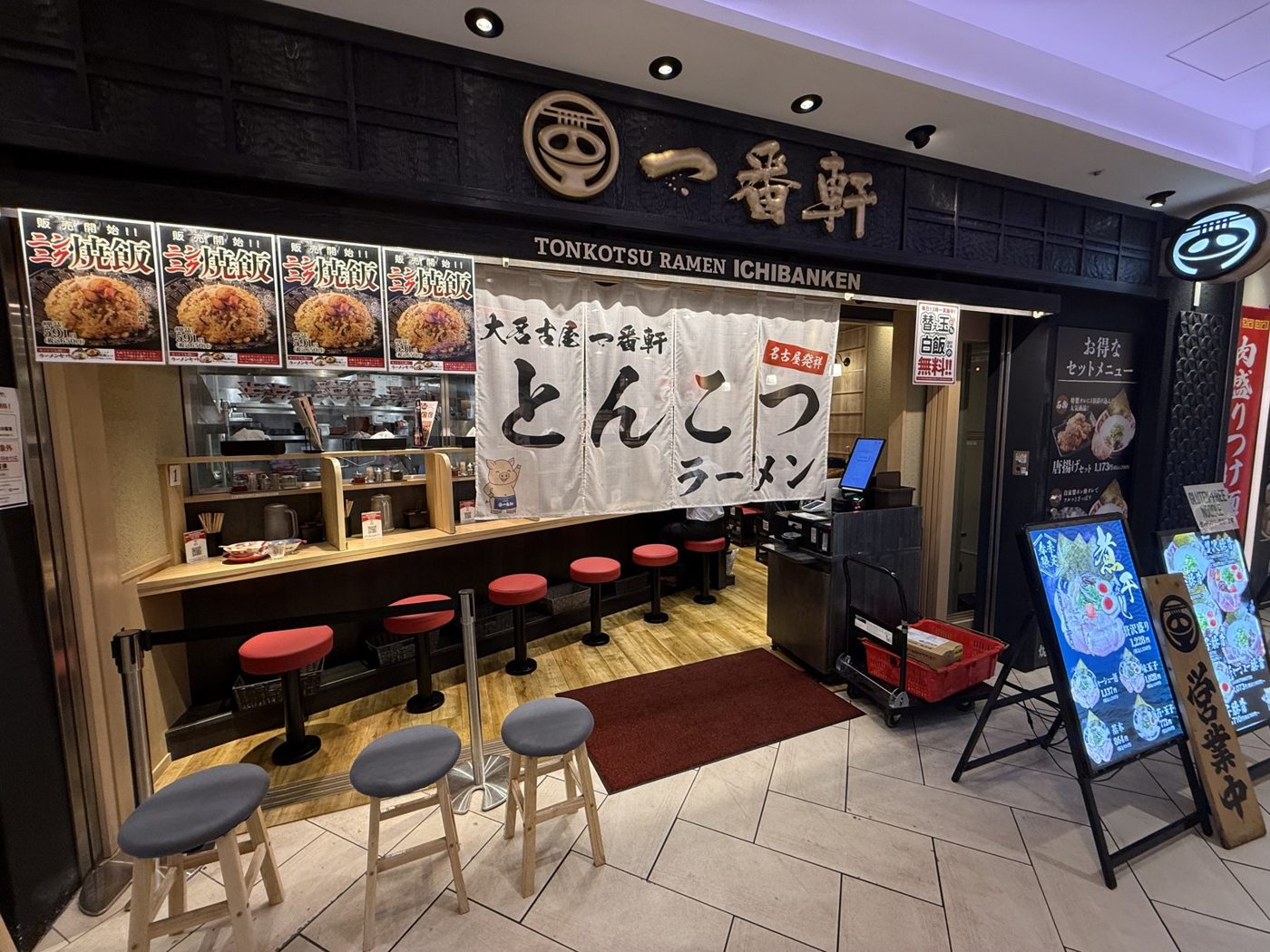
Here is where people get stuck:
- The menu is in Japanese and nobody will speak English
- They are going to ask you a question at the counter and you will not understand it
- There is a jar of something red on the table and you do not know if you are allowed to touch it
- Everyone else clearly knows something you do not
- You have heard the soup smells strong, and you are not sure you want that
- You will do something wrong and someone will notice
Each of those has an answer, and they are all below so you know before you walk in.
The short version
- Scan the QR code at your seat. No Japanese needed
- Ask for barikata because thin noodles soften as you eat
- Beni-shoga in at the start. Check the takana for red chilli before you decide when to add it
- Order kaedama when half your noodles are gone, and tip it in the moment it lands
- After 13:00, one kaedama or one bowl of rice is free
- Finish the soup if you want to see what is printed underneath. It is salty, though, and you do not have to
- On your way out, carry the bowl over and say gochisousama deshita
The rest of this page is why.
You order from your phone, and it speaks English
At this shop you do not speak at all. There is a QR code standing on the counter at your seat, with your seat number printed on it. You scan it with your phone, order on your own screen, and pay at the register when you leave.
The ordering screen is in Japanese, English, Chinese and Korean.
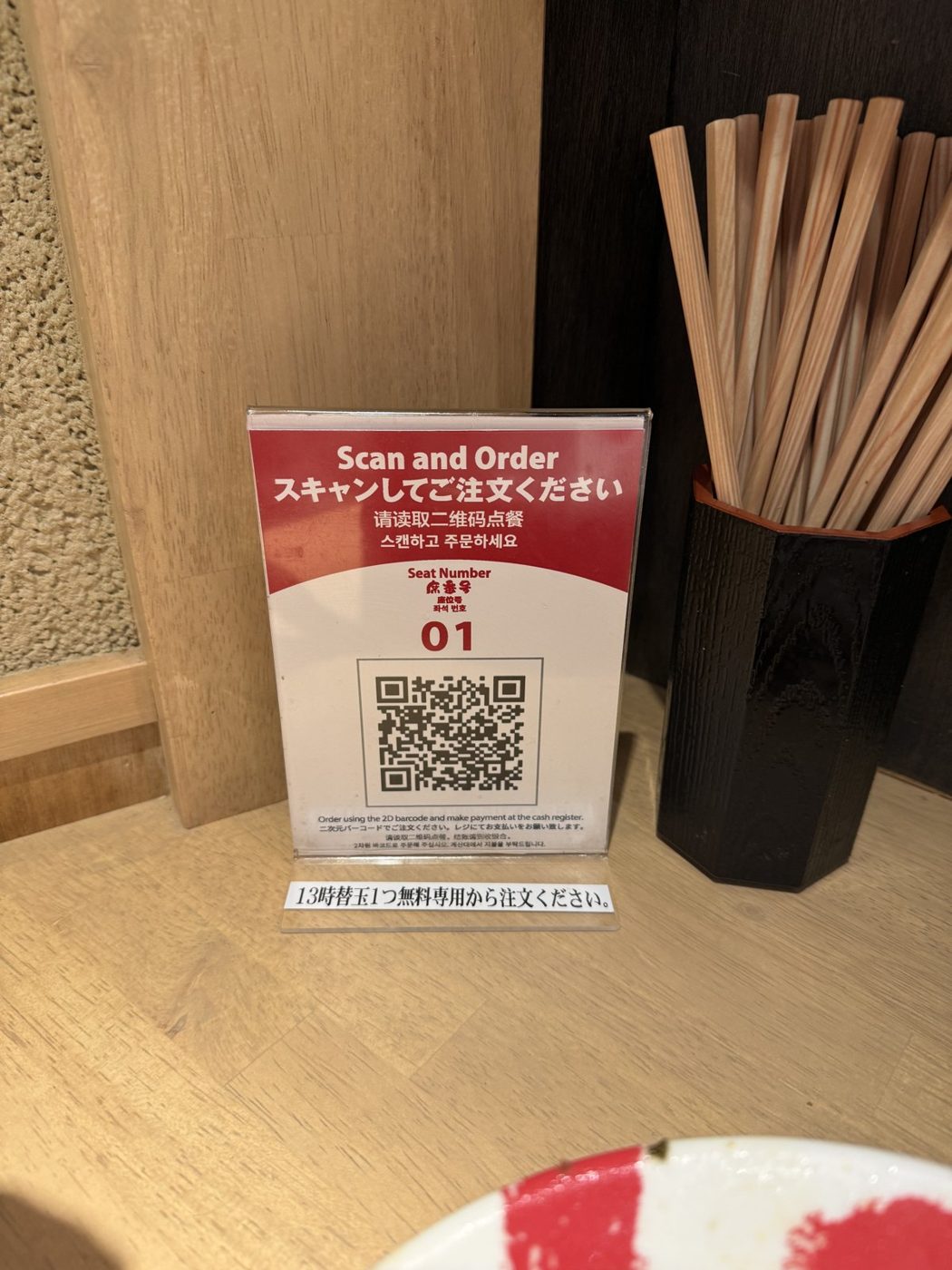
This is now normal in a lot of Japanese ramen shops, in one of three forms: a QR code like this one, a ticket machine by the door, or ordering out loud at the counter. If it is a ticket machine, look for the photos and press the top-left button. That is almost always the shop’s standard bowl.
The one question they will ask you
They are. It is this one: how firm do you want the noodles?
In most of Japan this is a minor preference. In Fukuoka there is a whole vocabulary for it, and from your answer the shop can tell whether you have done this before.
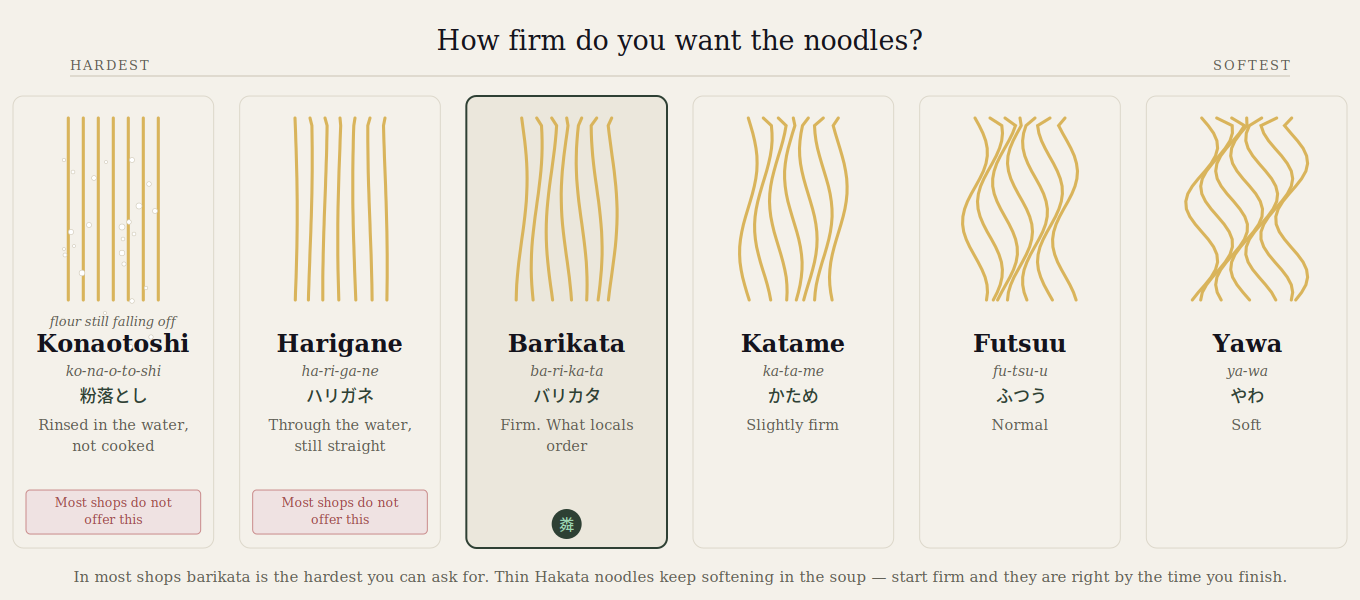
This is why the vocabulary exists, and nobody explains it: Hakata noodles are very thin, so they keep softening in the soup while you eat. If you start at barikata, by the time you reach the bottom of the bowl they have relaxed to about normal. If you start at normal, you finish on mush.
Barikata is not bravado. It is timing.
 IKI STYLE
the Japanese idea of cool
Say "barikata" and nothing else. No hesitation, no question mark at the end. One word. The staff will not react, which is the point: you have just ordered the way half of Fukuoka orders. If it is your first bowl in Japan and you want to hedge, say katame instead. Do not order konaotoshi to prove something.
The bowl is small on purpose
It is small on purpose, for the same reason the noodles are thin.
People in Fukuoka are impatient. That is my husband’s explanation, and he is right. Thin noodles cook in seconds, so a shop can put a bowl in front of you almost immediately, which matters in a city where lunch breaks are short.
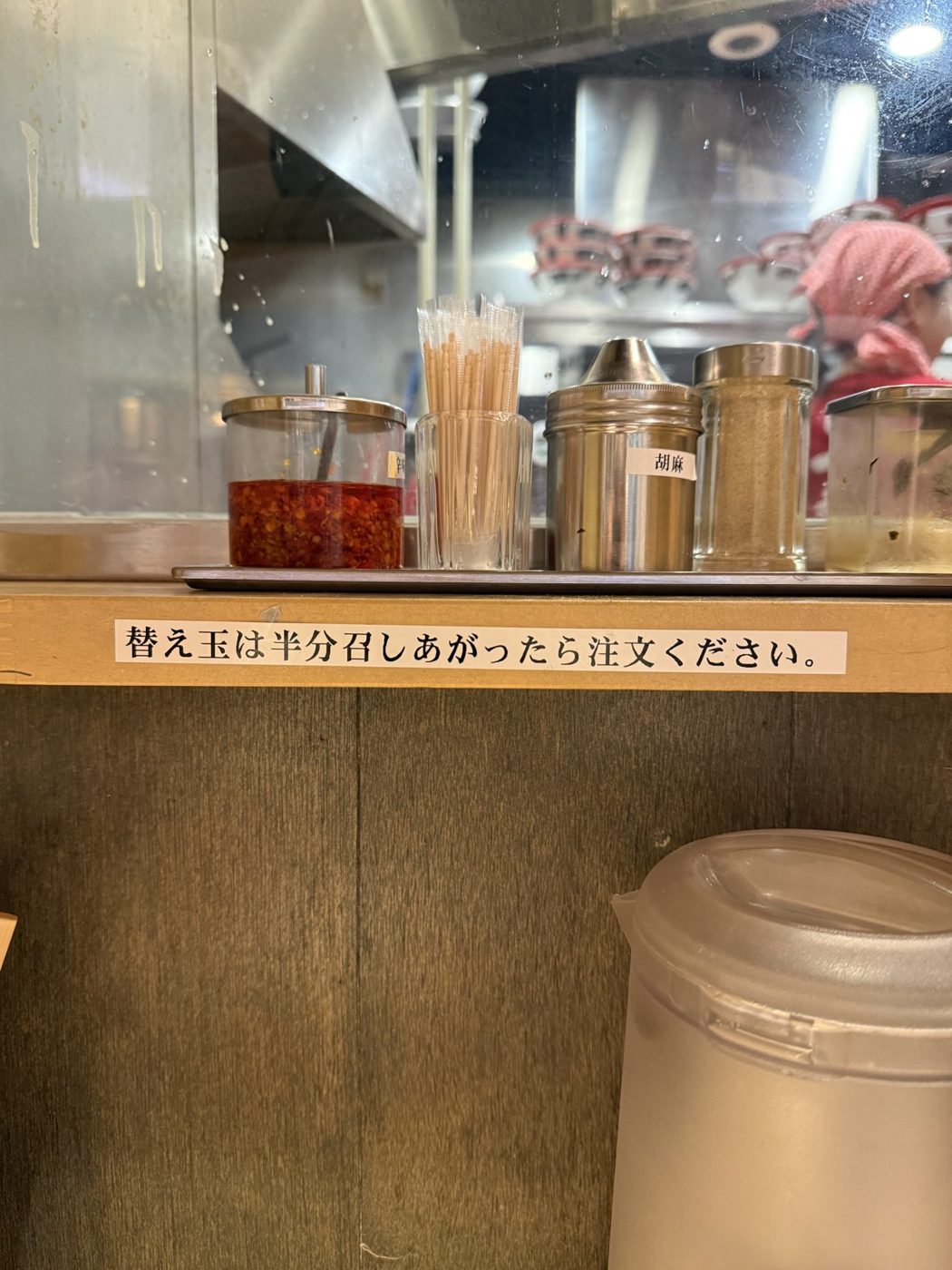
But thin noodles mean a small portion, so Hakata came up with this: kaedama is a second helping of noodles, cheap or free, that turns a small bowl into a full meal. At this shop it is 110 yen, and free after 13:00.
Kaedama is a normal part of the meal, and most locals order one without thinking about it.
Kaedama: ask when half the noodles are gone
Order it when about half the noodles in your bowl are gone.
This is the most useful thing on this page, and the reason for it is not obvious.
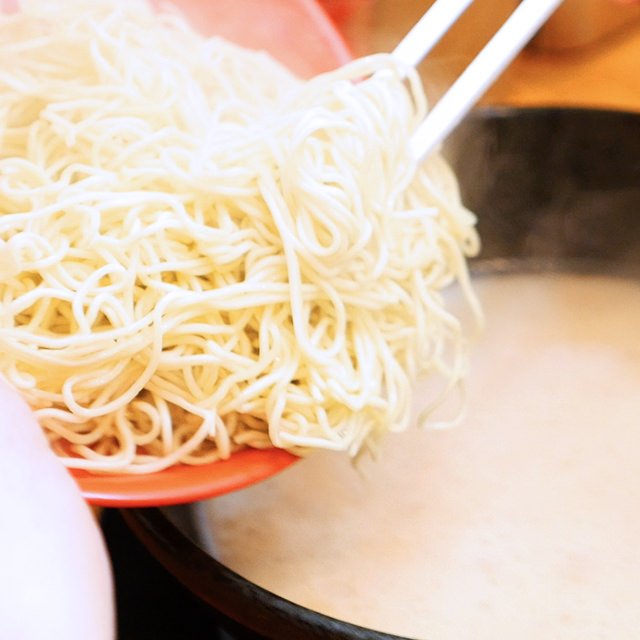
Kaedama does not arrive in soup. It arrives as a small plate or bowl of bare boiled noodles, nothing else. You tip them into the soup you already have.
So you need to use it quickly. Bare noodles left on the plate cool down, dry at the edges and clump together, and once they clump they do not come apart properly in the soup.
So the timing works like this:
- Half a bowl left is the right time. The kitchen takes a minute or so to boil the next batch, and it lands just as you finish the first lot. You tip it straight in.
- Too early means the plate arrives while you still have plenty of noodles, and sits there going cold and sticky while you catch up.
- Too late means you are sitting in front of a bowl of soup with nothing in it, waiting.
At this shop it is written on the wall, in Japanese, above the counter. Most shops do not tell you.
 TSŪ INFORMATION
what Japanese connoisseurs know
Tip the noodles in the second the plate lands, then eat. Do not stop to photograph it. The kaedama arrives dry and starts to clump straight away, which is half the reason locals eat so fast. If you want a second kaedama, order it at the same point again: halfway through the new lot.
The two jars on the counter are free
Yes. They are free, they are on the table for you, and helping yourself is part of eating the bowl and nobody will think you are taking too much.
There are two, and both will probably be unfamiliar.
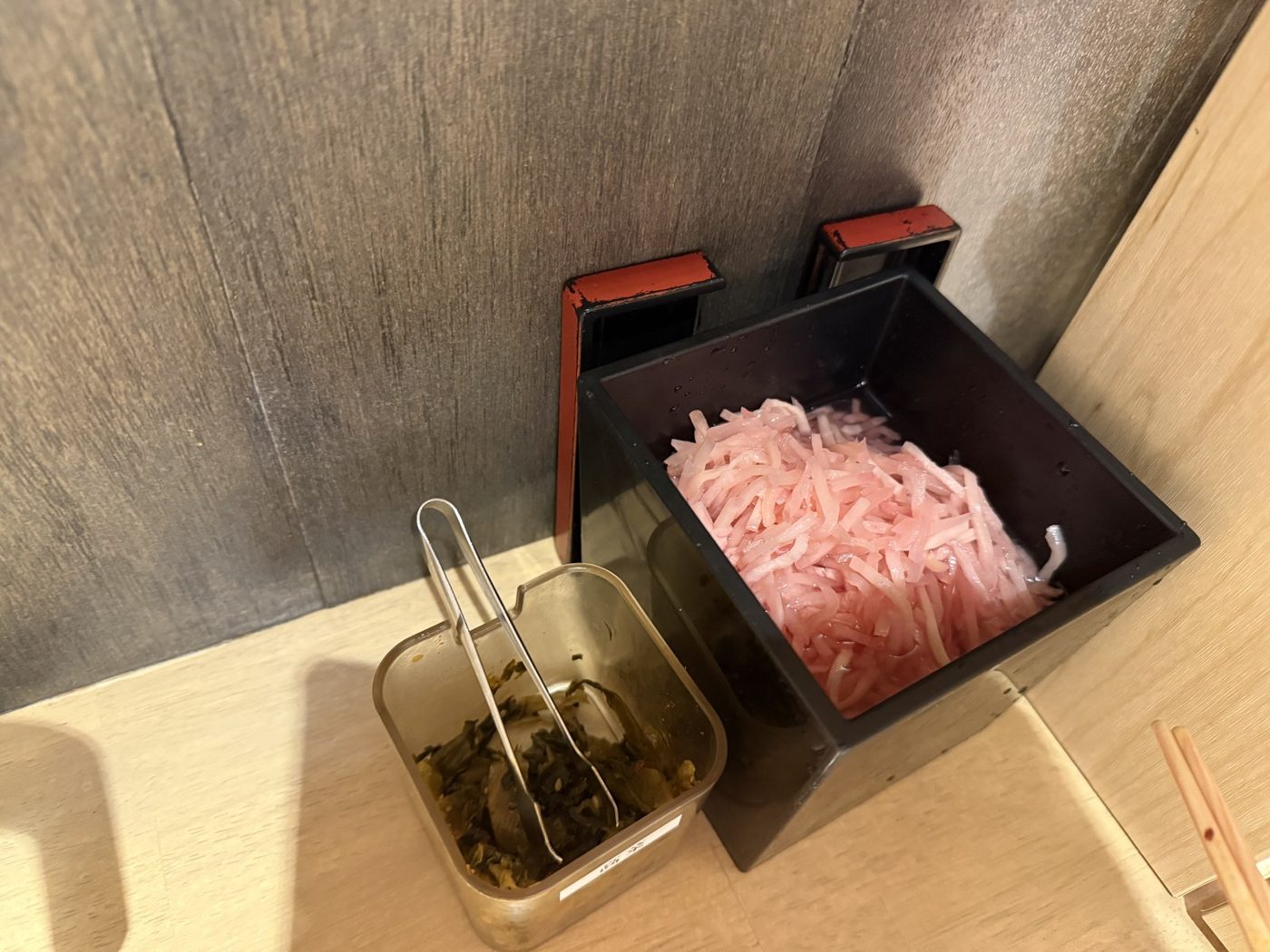
Beni-shoga is ginger, cut into fine threads and dyed bright pink. Japan uses it everywhere (on rice bowls, on okonomiyaki, in yakisoba) for two reasons: it looks good against brown and white food, and it resets your mouth. Anything rich, fatty or strong tends to arrive with beni-shoga beside it. Every gyudon (beef bowl) shop in the country keeps a pot of it on the table.
Takana is a Japanese leaf vegetable, pickled and seasoned. It is a vegetable, but you add it for the seasoning rather than the greens.
If it helps: think of both as pickles. Their job is to cut through a heavy bowl, and they are salty and sour enough to do it.
Beni-shoga goes in at the start. Always. My husband does not even think about it. The sharpness cuts the pork fat from the first mouthful, and the flavour of the bowl is designed around it.
Takana is the one that needs a decision, because the heat varies a lot from shop to shop. Some shops put out plain pickled greens with no chilli at all. Some put out karashi-takana, which is properly hot.
Judge it by the red. Look at the container before you take any. If you can see a lot of red chilli through the greens, it is hot. If it looks green-brown with barely any red, it is mild.
- Mild (put it in at the start, with the ginger)
- Hot (this is the fun one). Eat the first half of the bowl as it comes, then stir the takana in and eat the second half. The shop puts it there for exactly this. So you get clean tonkotsu first, then a hot, sharp version of the same soup. If you like heat, stirring it in is the best five seconds of the meal
That is exactly what my husband did here. He looked at the container, saw very little red, and spooned it straight in.
Free after 13:00, and nothing tells you in English
At this shop, yes, and it is worth timing your visit around.
Every day from 13:00, you get either one kaedama or one small bowl of rice, free. One or the other, not both. 100 g either way. Mini ramen is excluded.
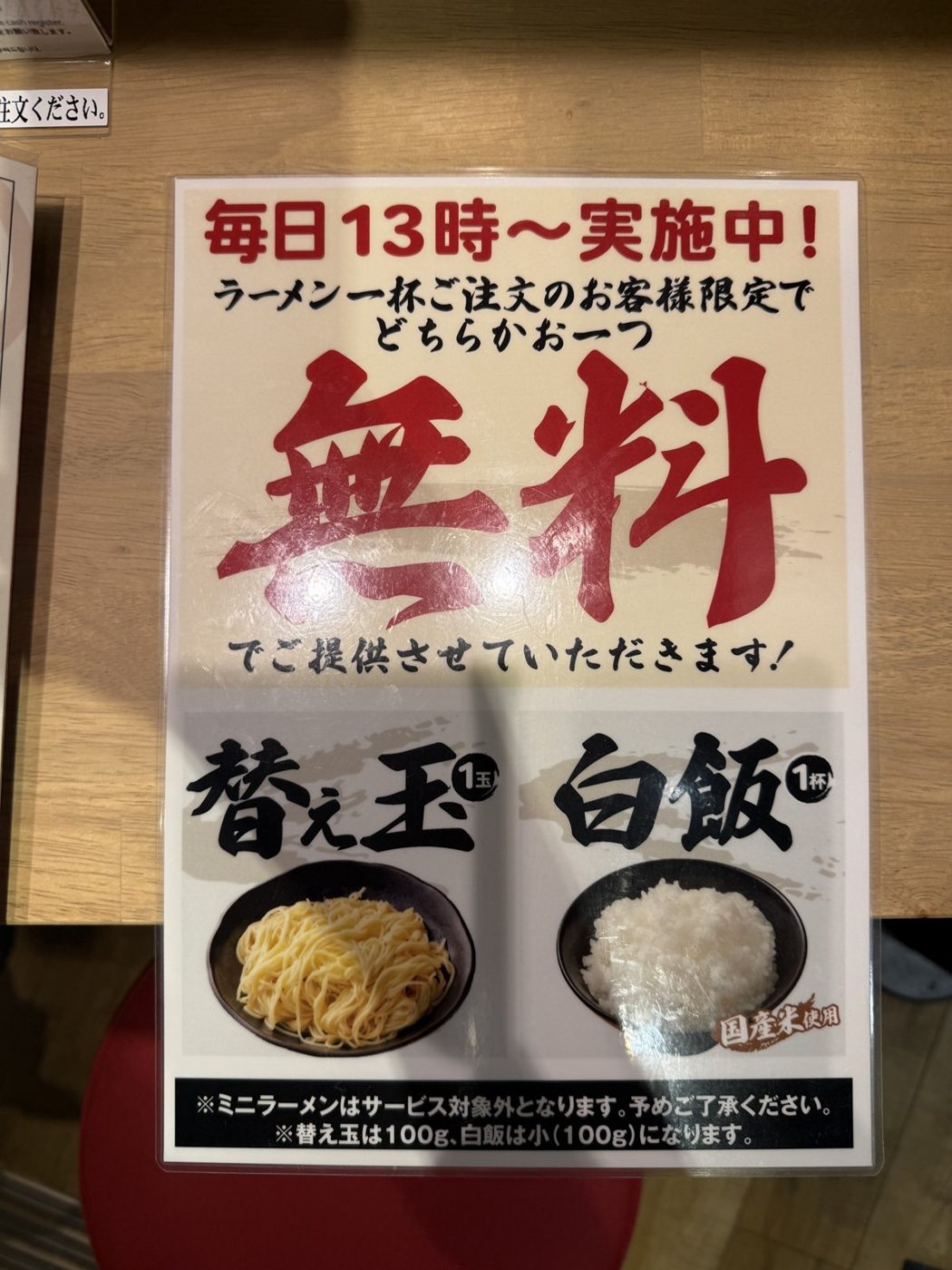
You order it through the same QR screen, from a separate free-items section. If you turn up at 13:05 instead of 12:45, your lunch costs less.
Offers like this come and go, so treat it as a reason to check rather than a guarantee. It was running when we visited in August 2026.
Finishing the soup, and one honest warning
In Fukuoka, you finish the soup when the ramen was good. You do not have to, and nobody is watching, but it is the clearest way to tell the shop you liked it without saying anything.
And a lot of shops reward you for it. Many tonkotsu shops print something on the inside bottom of the bowl (a line you can only read once the soup is gone). Very often it just says ありがとう (arigatou, thank you). Some shops write something longer.
At this shop, what appeared was the shop’s own mark and the year it opened.
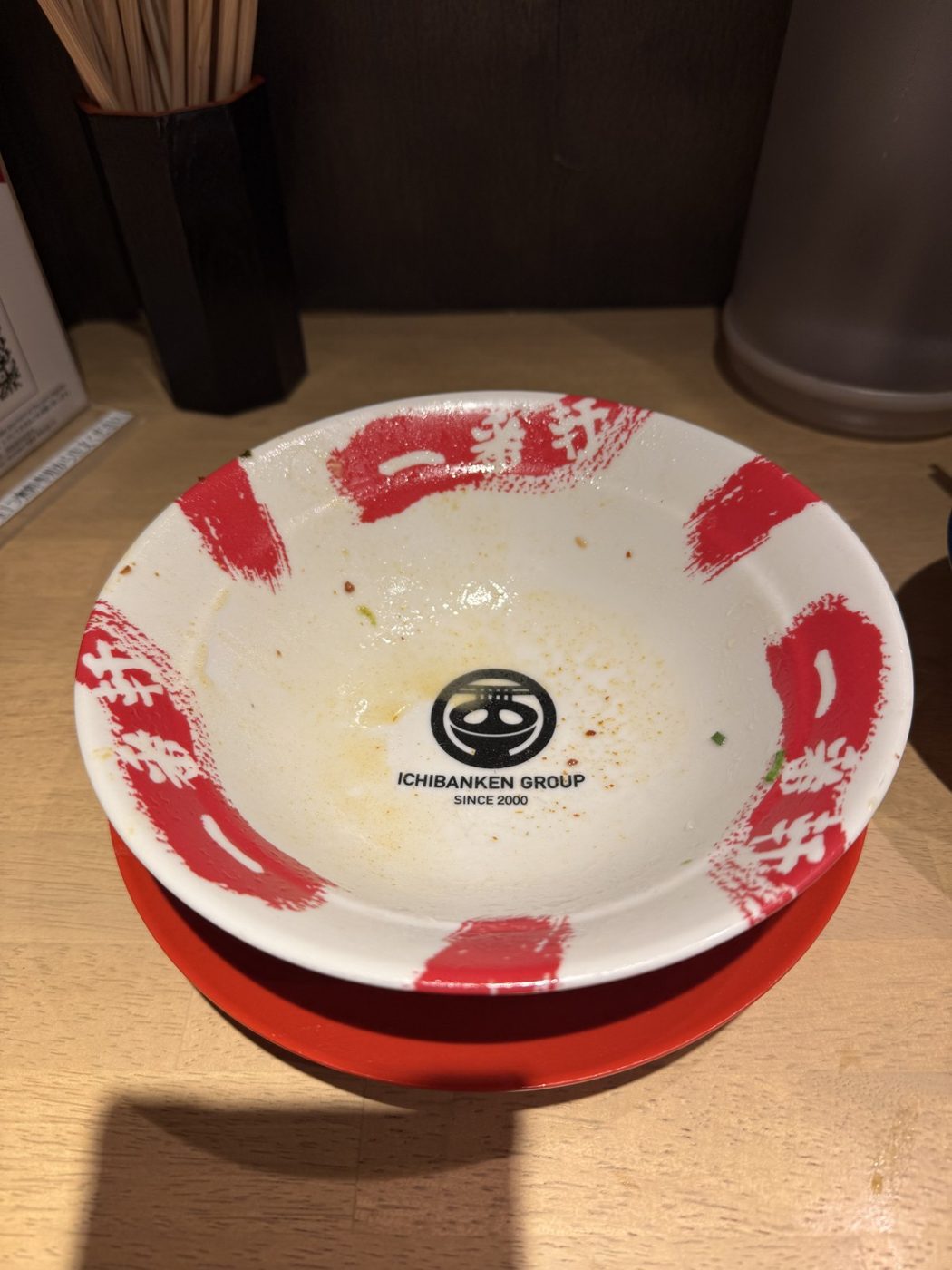
It is a small thing, only seen by the person who gets to the bottom, but once you know it is there you will want to look.
One honest warning, and please take it seriously. Tonkotsu soup is very salty, and a whole bowl is a lot of sodium in one sitting. If you have blood pressure to think about, or you are just being careful, leave the soup. Nobody will think less of you and my husband would tell you the same. Whatever is printed on the bottom of the bowl is not worth your health.
What to do when you stand up
This one surprised me most, but in Kyushu it is completely ordinary.
On your way out (not before), carry your bowl to the counter or the return stand, put it down, and say “gochisousama deshita”.
The reason is practical, and it explains a lot about how ramen shops work in Japan. A ramen shop depends on turnover: feeding as many people as possible, fast, at a low price. The slowest part is clearing tables, and when you carry your own bowl over, you save them that step.
You are not being polite to the staff. You are helping the next person get their lunch.
One honest note, because this matters: no shop asks you to do this, and it is not a rule anywhere in Japan. Some shops would rather you left the bowl where it is. Look for a return stand or a gap on the counter. If there is no obvious place, leave it on the table and walk out. That is fine, and it is what we did here, because this shop has nowhere to put it.
IKI STYLEthe Japanese idea of cool
Stand up, take the bowl, say it once on your way past. No need to bow or make a speech. You pick the bowl up as you stand, walk it to the counter, set it down, say gochisousama deshita without stopping, and keep going. My husband says it is the easiest thing a visitor can do to make a shop happy.
If there is nowhere obvious to put it, leave it on the table, which is fine. This shop had no return counter, so we left ours where they were, but look first.
The one thing not to do
There is almost nothing you can get wrong in a ramen shop. Slurping, eating fast and using your phone are all fine, and eating alone is normal.
The one thing my husband would ask: do not leave the counter swimming in soup.
Tonkotsu is a fatty soup and splashes do not come off in one wipe. Somebody has to clean it properly, and while they are cleaning, that seat is not available. It is the same logic as carrying your bowl over: a small mess costs the shop time, and the person who waits is whoever is next in line.
Show this to the staff
You will not need any of these at this shop, because you order on your phone. At a counter shop in Fukuoka, these six cover almost everything.
| バリカタで | barikata de | Firm noodles, please |
| 替え玉お願いします | kaedama onegai shimasu | Extra noodles, please |
| おすすめは何ですか | osusume wa nan desu ka | What do you recommend? |
| これは辛いですか | kore wa karai desu ka | Is this spicy? (point at the takana) |
| 一人です | hitori desu | Just one person |
| ごちそうさまでした | gochisousama deshita | Thank you for the meal (on your way out) |
What a Fukuoka native thought of this bowl
His verdict, in his own words: the smell was clean.
Real Hakata tonkotsu has a funk to it: a strong pork-bone smell that reaches you before the bowl does. If you grew up with it, that is the smell of home. My husband likes it, and he will tell you a shop without it is missing something.
But he also knows most people do not like it, and that plenty of visitors take one breath, decide tonkotsu is not for them, and never try again.
This bowl tasted like proper tonkotsu and barely smelled of anything. The soup is boiled from thirty-five pigs’ worth of bones and the shop uses only the first extraction, never a reboiled stock. That is why it tastes so clean.
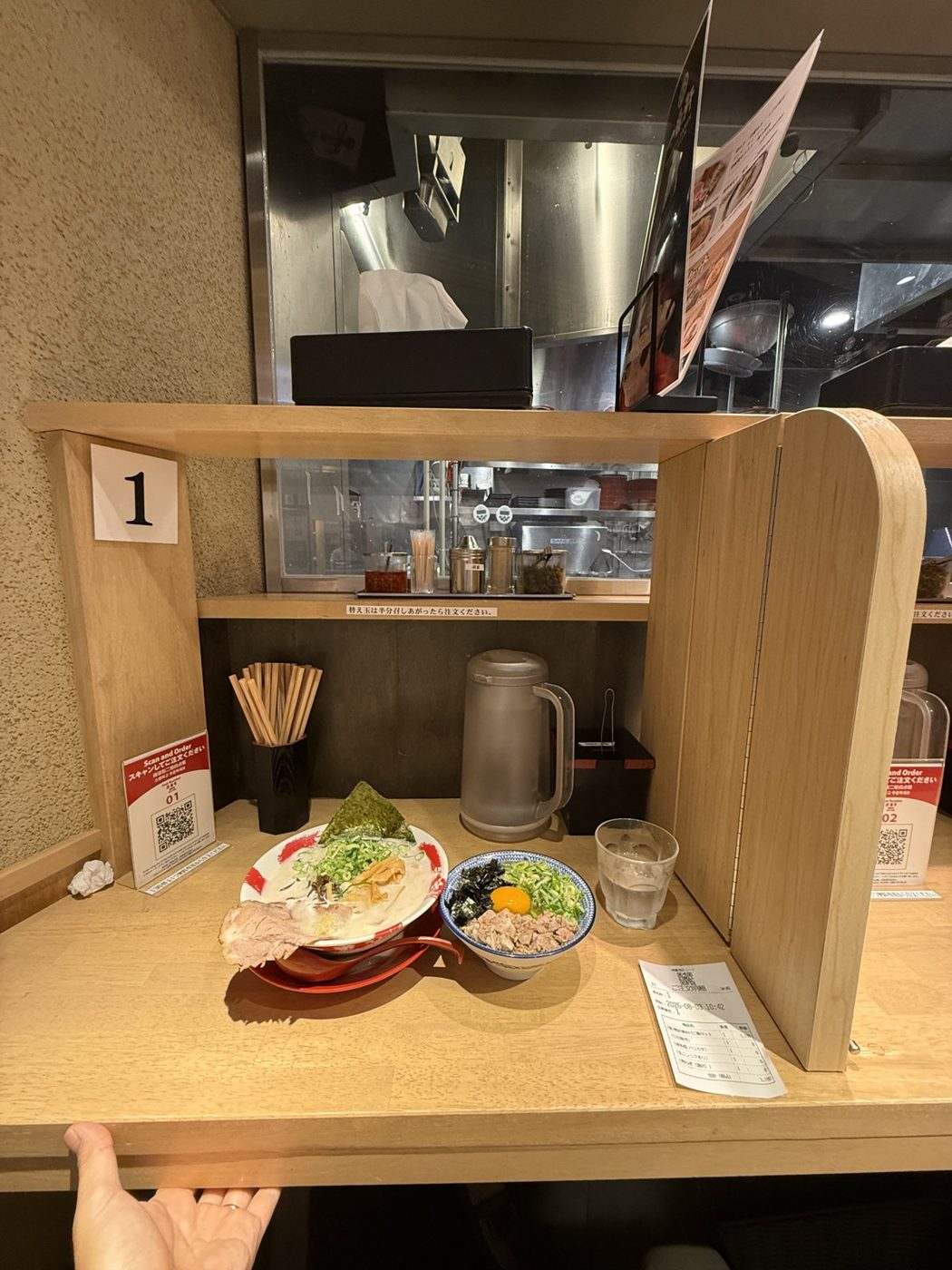
So my recommendation is a specific one, and it comes from someone who actually prefers the funk: if the smell is what put you off tonkotsu, this is the bowl to try. You get all of the flavour without the smell that puts people off.
What it costs
Every price here was read off the menu on the table in front of us and paid on our own card. Tax-included prices are what you actually hand over.
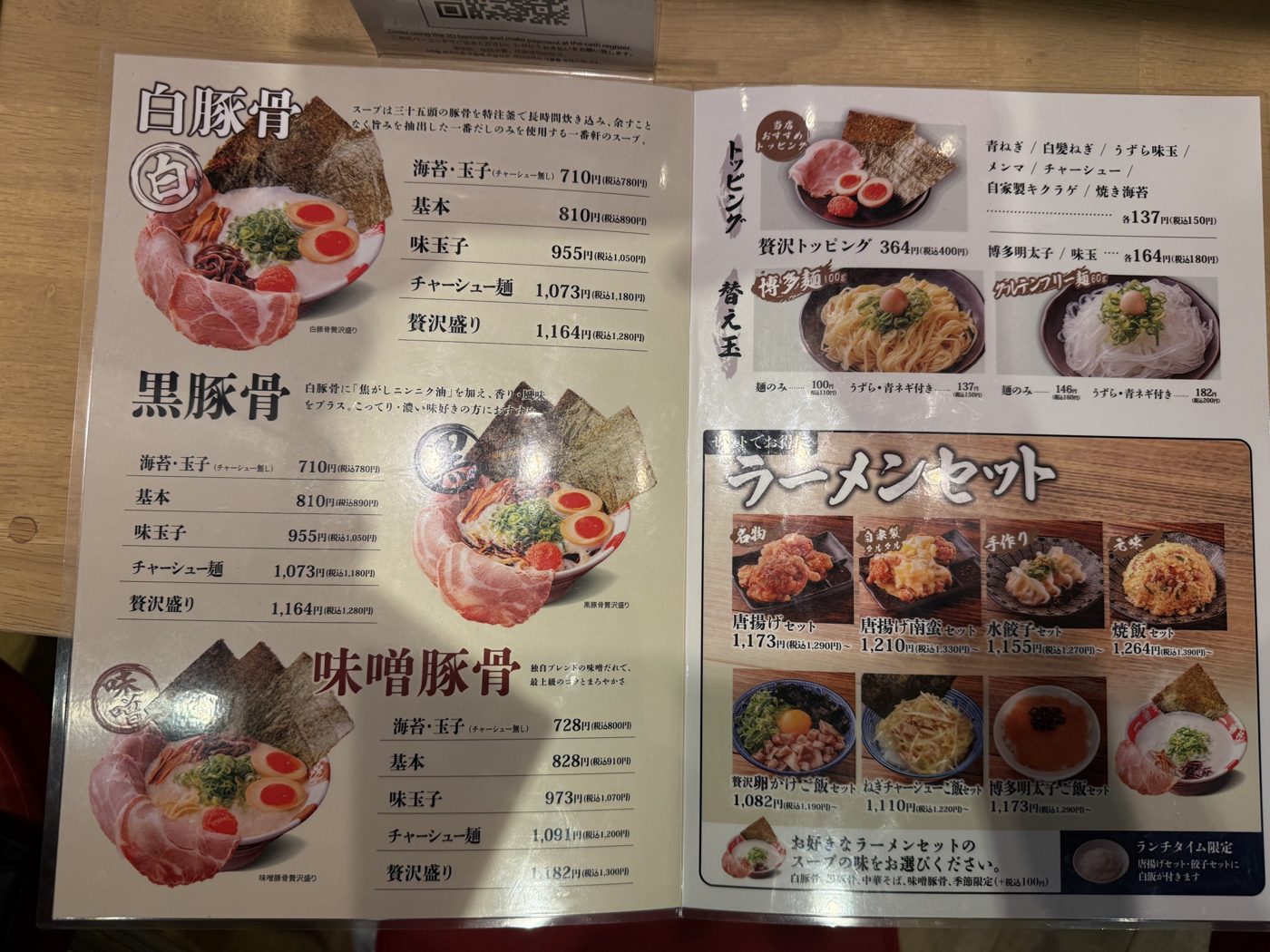
Shiro tonkotsu (white, the classic) and kuro tonkotsu (black, the same soup plus burnt garlic oil) cost the same:
| Tax-excl. | You pay | |
|---|---|---|
| Nori & egg (no chashu) | ¥710 | ¥780 |
| Standard | ¥810 | ¥890 |
| With seasoned egg | ¥955 | ¥1,050 |
| Chashu-men (extra pork) | ¥1,073 | ¥1,180 |
| Zeitaku-mori (everything) | ¥1,164 | ¥1,280 |
Miso tonkotsu runs slightly higher: ¥800 / ¥910 / ¥1,070 / ¥1,200 / ¥1,300.
| Kaedama (extra noodles) | You pay |
|---|---|
| Hakata noodles, 100 g (noodles only) | ¥110 |
| Hakata noodles, with quail egg & spring onion | ¥150 |
| Gluten-free noodles, 60 g (noodles only) | ¥160 |
| Gluten-free, with quail egg & spring onion | ¥200 |
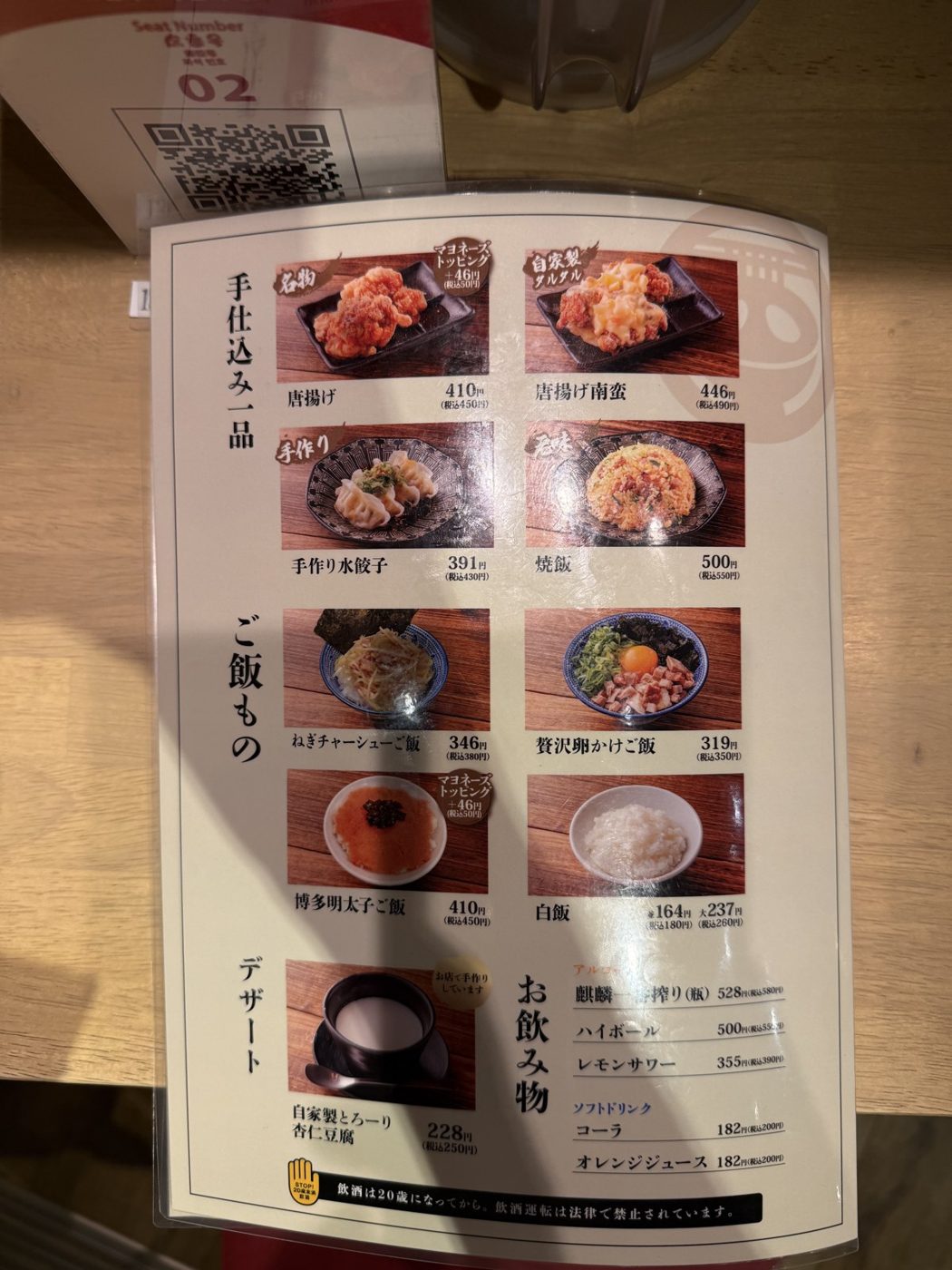
| Sides and rice | You pay |
|---|---|
| Karaage (fried chicken, the house speciality) | ¥450 |
| with mayonnaise | +¥50 |
| Karaage nanban, house tartare | ¥490 |
| Hand-made boiled gyoza | ¥430 |
| Fried rice | ¥550 |
| Spring onion & chashu rice bowl | ¥380 |
| Raw egg rice bowl with chashu | ¥350 |
Toppings are ¥150 each: spring onion, white onion, quail egg, menma, chashu, house wood-ear mushroom, roasted nori. Hakata mentaiko or a seasoned egg is ¥180.
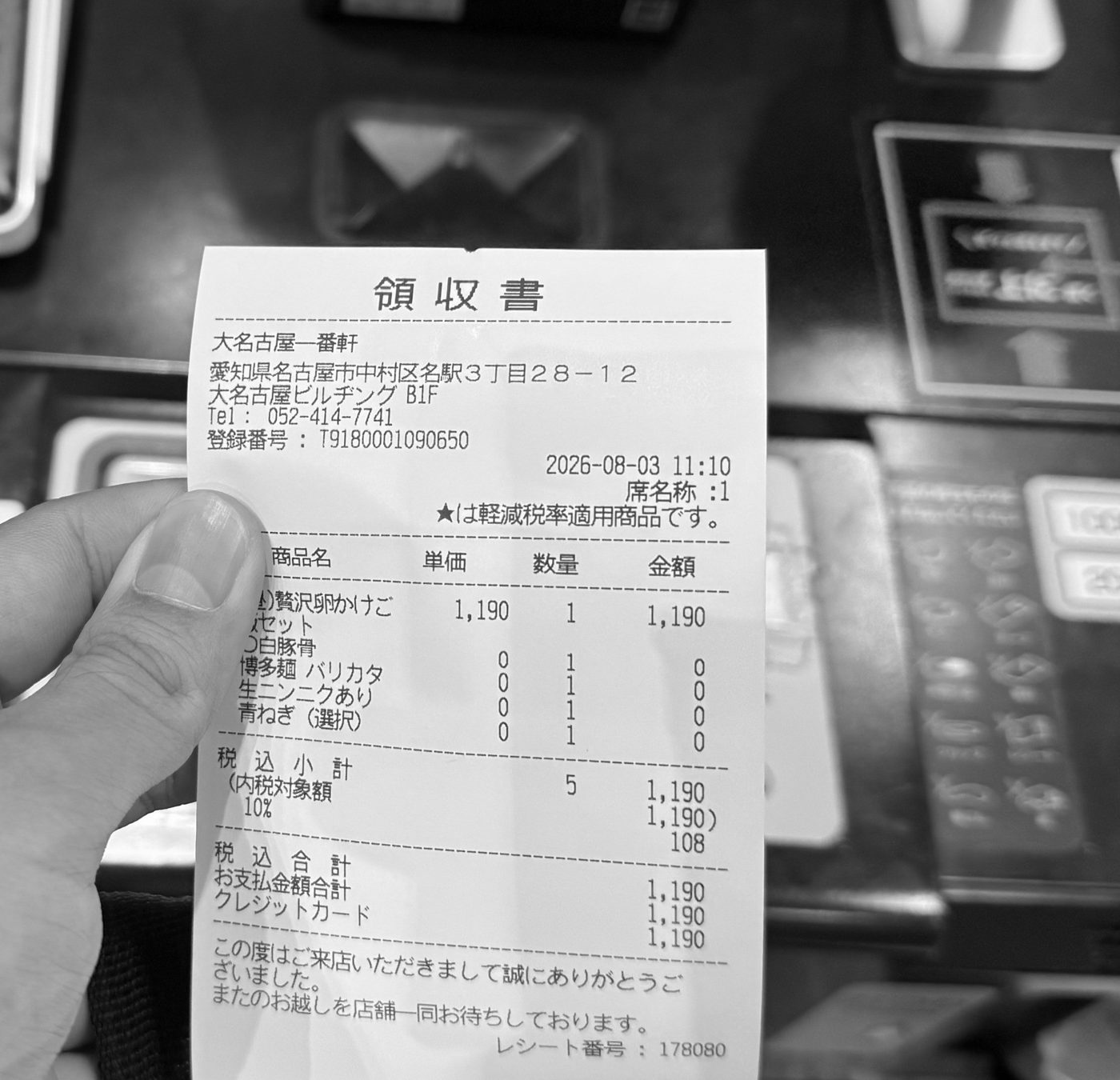
Sets (a bowl of ramen plus a rice bowl or a side) start at ¥1,190. We paid ¥1,190 for the raw-egg rice bowl set with shiro tonkotsu, barikata.
Quick facts
| Shop | Dai-Nagoya Ichibanken (大名古屋一番輱) |
| Where | Dai Nagoya Building B1F, 3-28-12 Meieki, Nakamura-ku, Nagoya |
| Getting there | Underground from Nagoya Station, about two minutes |
| Ordering | QR code at your seat. Japanese, English, Chinese, Korean |
| Paying | Cards accepted. We paid by card |
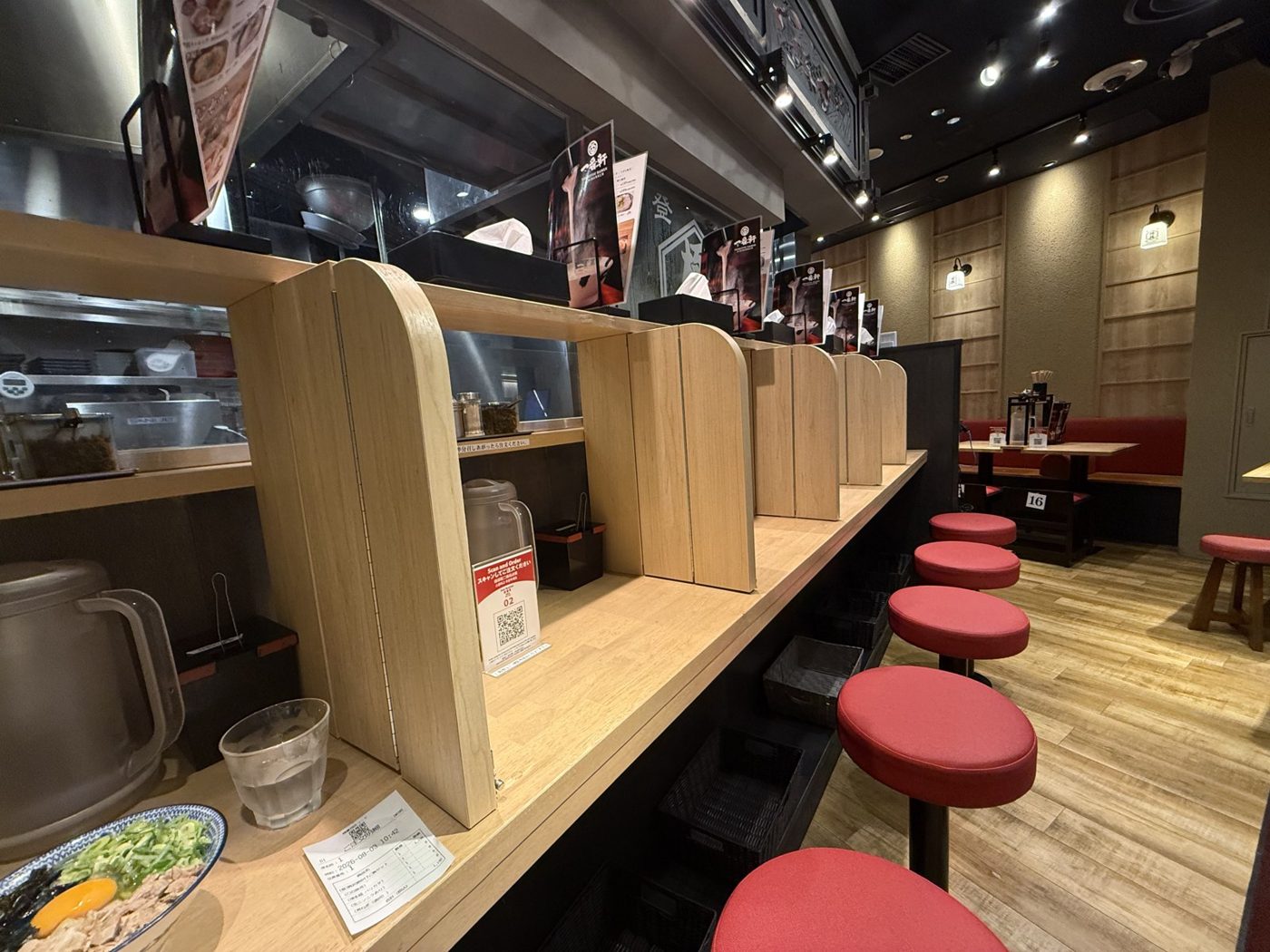
| Seating | Single seats with wooden dividers, plus normal tables at the back |
| Gluten-free | Yes, gluten-free noodles are on the menu. Rare in ramen shops |
| Visited | 3 August 2026, 11:10 |
FAQ
Can I go in alone?
Yes, and plenty of people do. Eating ramen alone is normal in Japan; at lunchtime most of the counter is people on their own. The divider seats at this shop exist because so many people come alone.
Can I bring children?
Yes. Ramen shops with children in them are common, and this one has normal tables at the back as well as the counter seats.
Is there a gluten-free option?
At this shop, yes: gluten-free noodles are on the menu at ¥160. This is rare. Most ramen shops have no gluten-free option at all, so do not assume it anywhere else. Note that the soup and toppings are not certified gluten-free; if you are coeliac rather than avoiding gluten by choice, ask before you order.
Is the free kaedama after 13:00 available to everyone?
Yes, anyone can get it, with no membership or app. It was running in August 2026, but offers like this are not permanent, so do not plan around it.
What if I do not want the extra noodles?
Then do not order them. Nobody expects you to. A single bowl is a normal lunch.
Do I have to slurp?
No. Slurping is fine and normal, and nobody minds if you do not.
What is the difference between shiro and kuro?
Kuro is the same soup with burnt garlic oil stirred in: darker, heavier, more aroma. If it is your first tonkotsu, start with shiro so you can taste the soup itself.
• Scan the QR on your seat · the screen has English, Chinese and Korean
• Say barikata because the noodles soften in the soup as you eat
• Red ginger in at the start · taste the mustard greens first, then decide
• Order kaedama when half the noodles are gone, not when you finish
• After 13:00: one kaedama or one small rice, free (mini ramen excluded)
• Standard bowl ¥890 · our set ¥1,190 · visited 3 August 2026, 11:10
• We paid for our own lunch · nobody paid us anything · the two booking links near the end of this page are affiliate links
More from the same city: the Osu neighbourhood on foot and the pizza counter we go to when we want to celebrate a Tuesday.
Before the ramen, there was breakfast: in this city a coffee comes with toast and an egg, free, until 11:00.
About us · Contact · Privacy Policy · Disclosure
Affiliate links: if you book through them we may earn a small commission, at no extra cost to you.
Planning the trip
Coming to Nagoya? These guides cover the rest of the trip, with prices we paid or checked ourselves.
- Shinkansen prices from Nagoya: what we paid to Tokyo, Osaka and Kyoto →
- Ghibli Park tickets and access: a Nagoya local’s guide →
- Nagoya airport to Nagoya Station: ¥980 by train, 29 minutes →
- Where to stay in Japan: business hotel, ryokan or capsule →
- Getting online in Japan: eSIM and pocket WiFi, real 2026 prices →