Written from Nagoya — the food Japan invented while pretending to copy the West, served inside the station you were only passing through.
💴 Cost: ¥2,090 for a single dish · ¥3,850 for the plate with everything on it
📍 Where: JR Central Towers 12F — inside Nagoya Station, not a walk from it
⚠️ Hardest part: finding the lift. The restaurant floor sits above the department store
1. This is where yōshoku comes from. Not a themed restaurant — the actual company that started it, trading since 1902
2. Order the Hanatsubaki Plate, ¥3,850. Prawn fry, meat croquette, hamburg and chicken rice on one plate. The whole genre in a single order
3. It is inside Nagoya Station. You can do this in a Shinkansen transfer window and never step outside
There is a category of Japanese food that almost no visitor has a name for, even though most of them eat it.
Curry that bears no relation to Indian curry. An omelette folded around ketchup rice. A hamburger patty with no bun, under brown sauce. Deep-fried prawns the length of your hand. Croquettes.
The word is yōshoku (洋食) — literally “Western food”. It is not Western food. It is what happened when Japanese cooks in the early 1900s were handed European recipes and Japanese ingredients and told to work it out, and it has been drifting away from its source for a hundred and twenty years since. It is now entirely its own cuisine, and it is what people here eat when they want to be comforted.
If you want the original version of it, there is a specific address in Ginza. There is also a second one inside Nagoya Station, which is a great deal easier to get to.
A cosmetics company started it, more or less by accident
Shiseido is a cosmetics company. You have seen the counters in airports. What is less obvious is that Shiseido began as a pharmacy in Ginza, and that its founder came home from the 1900 Paris Exposition by way of America with an idea that had nothing to do with either.
He had seen American drugstores, where one corner of the shop sold fizzy drinks and ice cream. In 1902 he built one into his pharmacy: Japan’s first soda fountain.
He did not improvise it. The machinery, the glasses, the straws, the spoons and the syrup were all shipped in from America, on the principle that if you are going to do a thing you do the real version of it. Geisha from the Shinbashi district became the regulars. By 1928 the soda counter had become a full restaurant.
Two things follow from that, and both are still on the menu. The ice cream soda in Japan starts here. And so does a particular idea of what Western food ought to taste of, once a Japanese kitchen has finished with it.
The plate that explains the whole cuisine
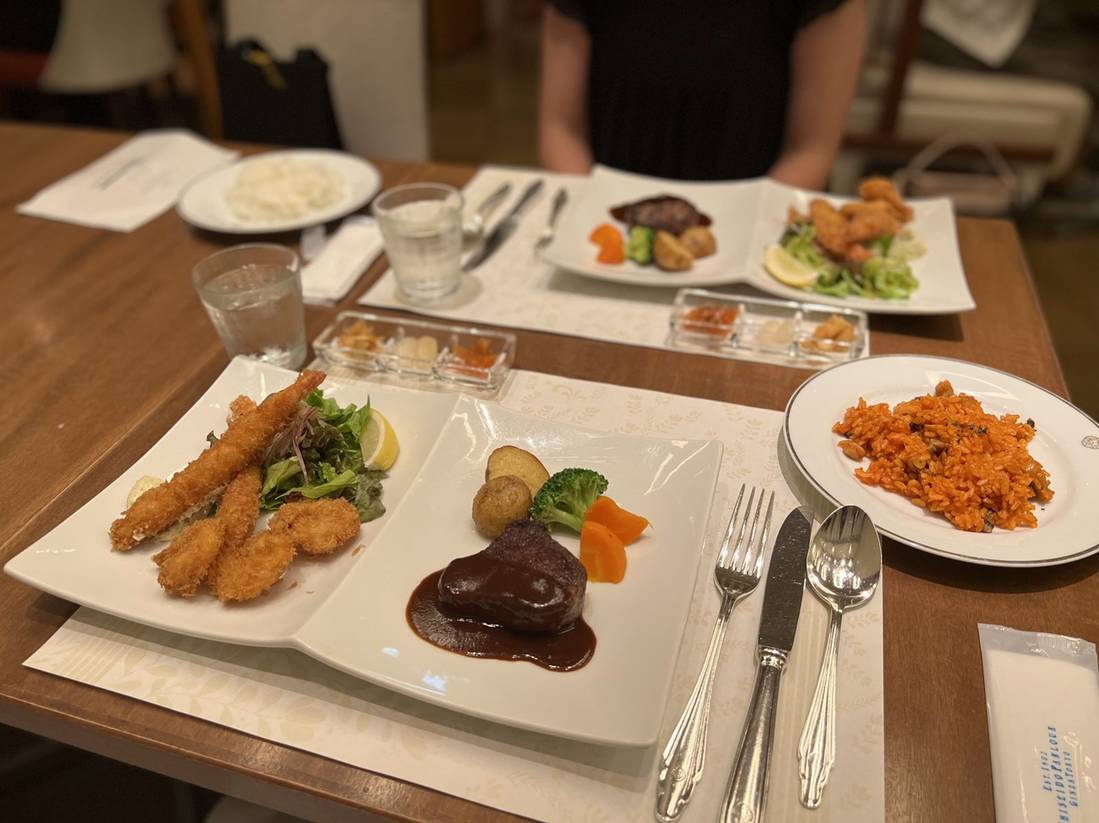
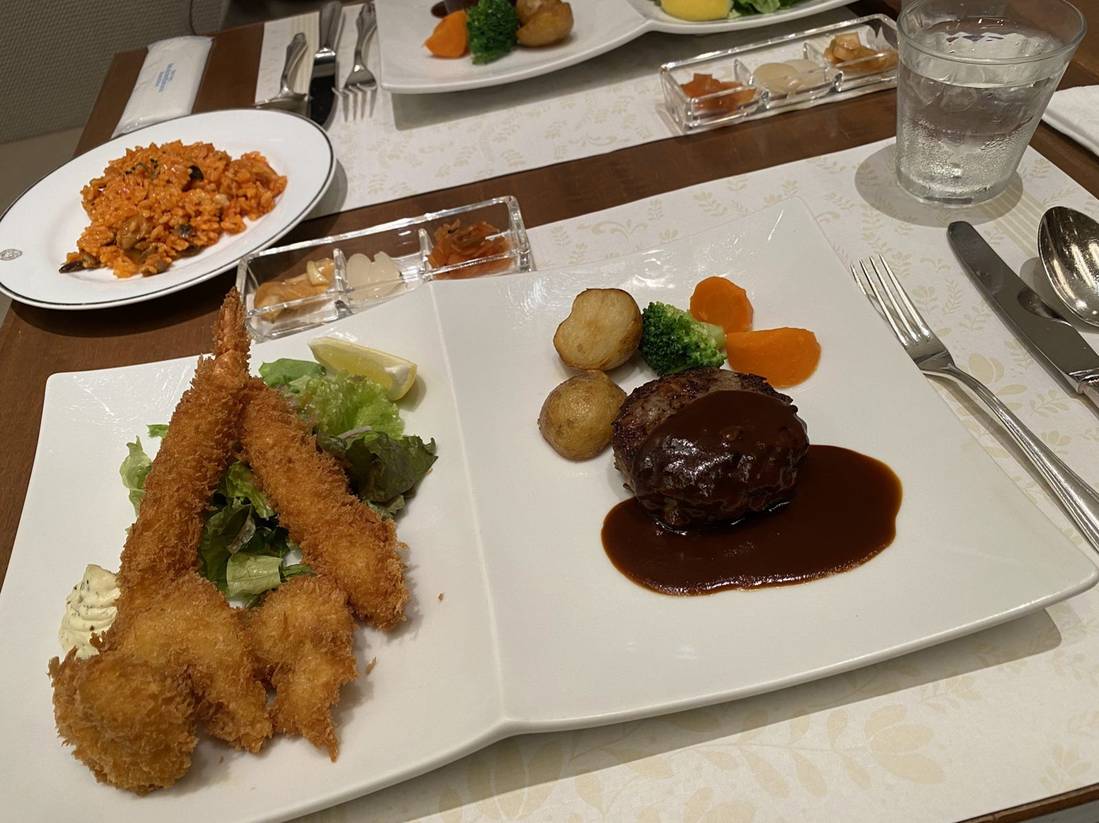
Order one dish and you learn one thing. Order the Hanatsubaki Plate — ¥3,850 — and you get four of the founding dishes of yōshoku arranged on one long plate, which is a faster education than any amount of reading.
What arrives:
- Ebi fry — prawns in fine breadcrumbs, with tartare sauce and a salad. Bigger than you expect, and crunchier
- Meat croquette in tomato sauce — the dish this restaurant is most known for. Not the potato croquette you are picturing. Minced beef, and much richer
- Hamburg under brown sauce, with a few boiled vegetables arranged around it. You can pay ¥1,320 more to swap this for a domestic beef fillet steak, and you should not
- Chicken rice — the orange one. Rice fried with chicken and tomato. This is the filling that goes inside an omurice, served on its own
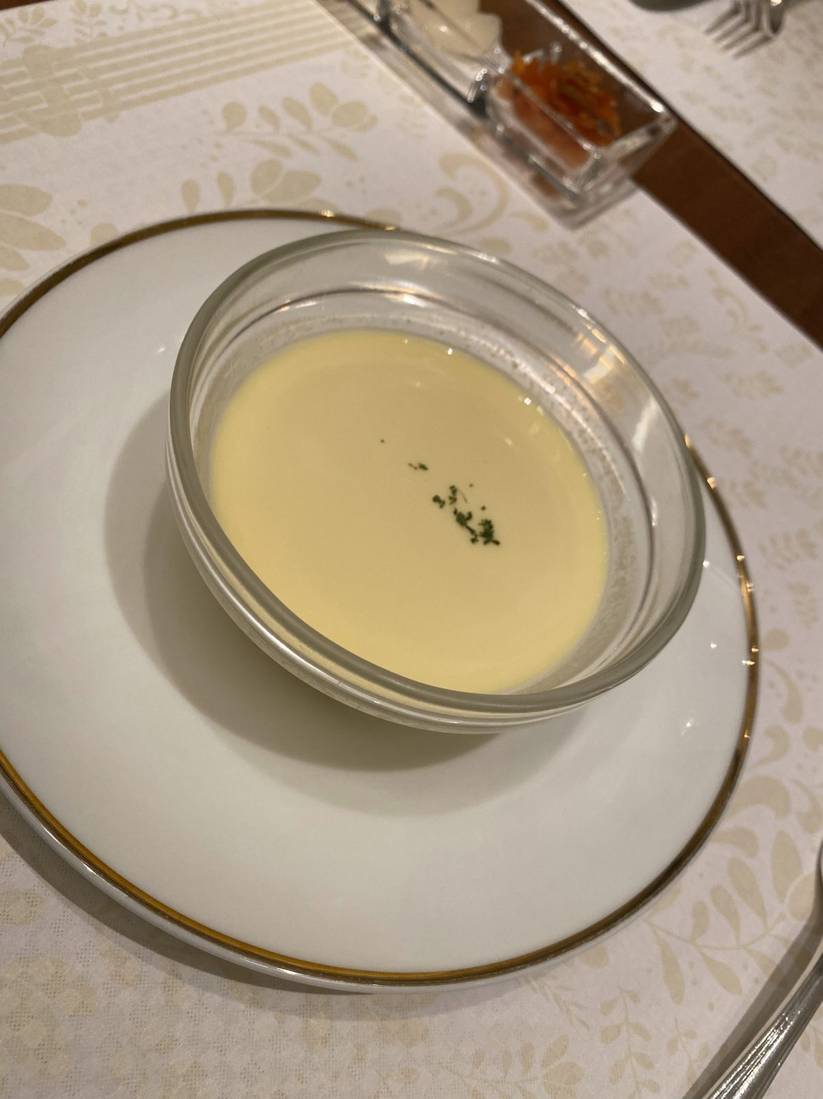
- A soup, and coffee or tea afterwards
The vegetables come in tiny separate glass dishes, the tablecloth has a pattern woven into it, the water glass is heavy. None of this is ironic. This is a restaurant that has been doing exactly this since before the war and sees no reason to modernise the parts that work.
what Japanese connoisseurs know
The chicken rice is the tell. If you have eaten omurice in Japan and wondered what was inside it, this is it, uncovered. Ordering it on its own is what people did before somebody thought to wrap it in egg — and it is still on the menu at ¥2,090, seventy years after the omelette version overtook it.
What everything costs
From the restaurant’s own menu, checked August 2026. All prices include tax.
| Hanatsubaki Plate (the four-dish plate) | ¥3,850 |
| Omurice | ¥2,530 |
| Meat croquette, Shiseido Parlour style | ¥2,310 |
| Beef curry rice · seafood curry rice | ¥2,420 |
| Chicken rice | ¥2,090 |
| Small prawn and mushroom doria | ¥2,200 |
| Seafood macaroni gratin, tomato sauce | ¥2,090 |
| Seasonal fruit parfait | ¥2,640–2,860 |
| Kids’ plate (primary school and under) | ¥1,870 |
| Weekday lunch plate, 11:00–14:00 (Nagoya only) | ¥3,080 |
This is not cheap, and I am not going to pretend otherwise. A bowl of ramen two floors down in the same station is ¥890. What you are paying for is a kitchen that has cooked the same six dishes for a century, and a dining room that still behaves as though it is 1955.
Save room, because the parfait is the other reason to come
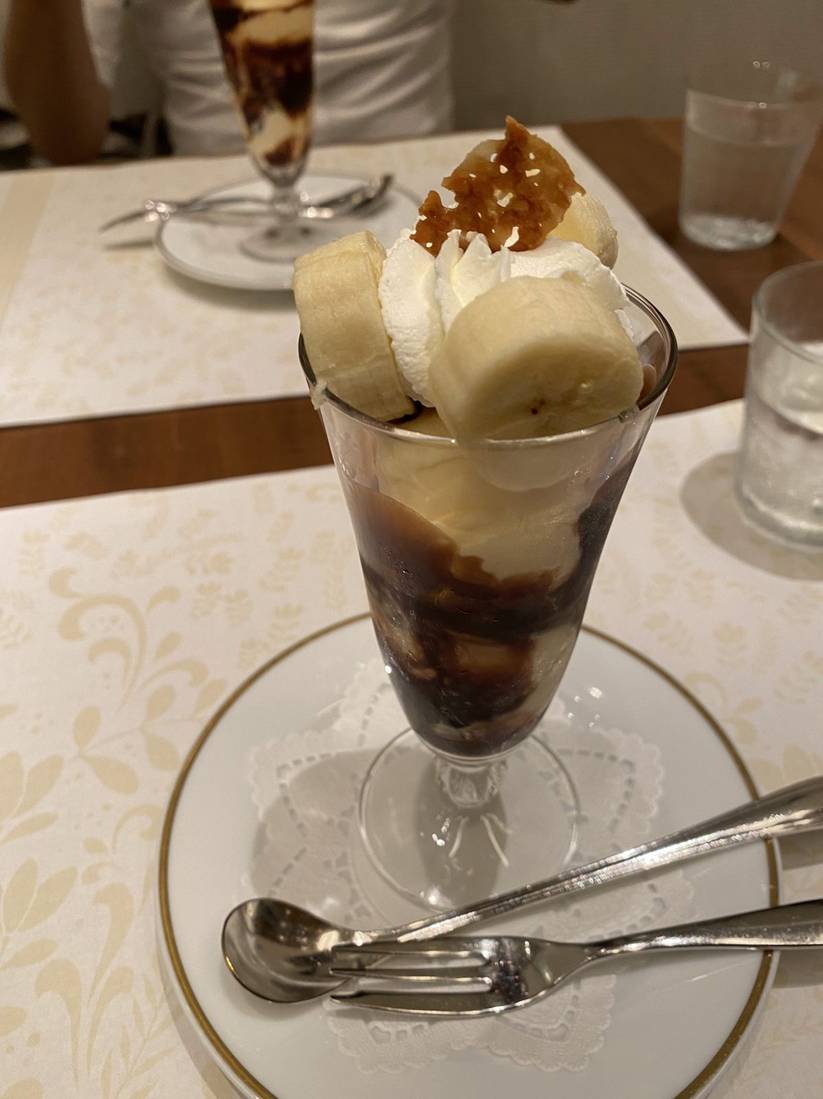
A company that began by importing an ice cream machine takes its desserts seriously, and the seasonal parfaits are where that shows. They are built in tall glasses in layers — sorbet, ice cream, jelly, the fruit itself — and they change with what is in season, which in Japan means they change constantly.
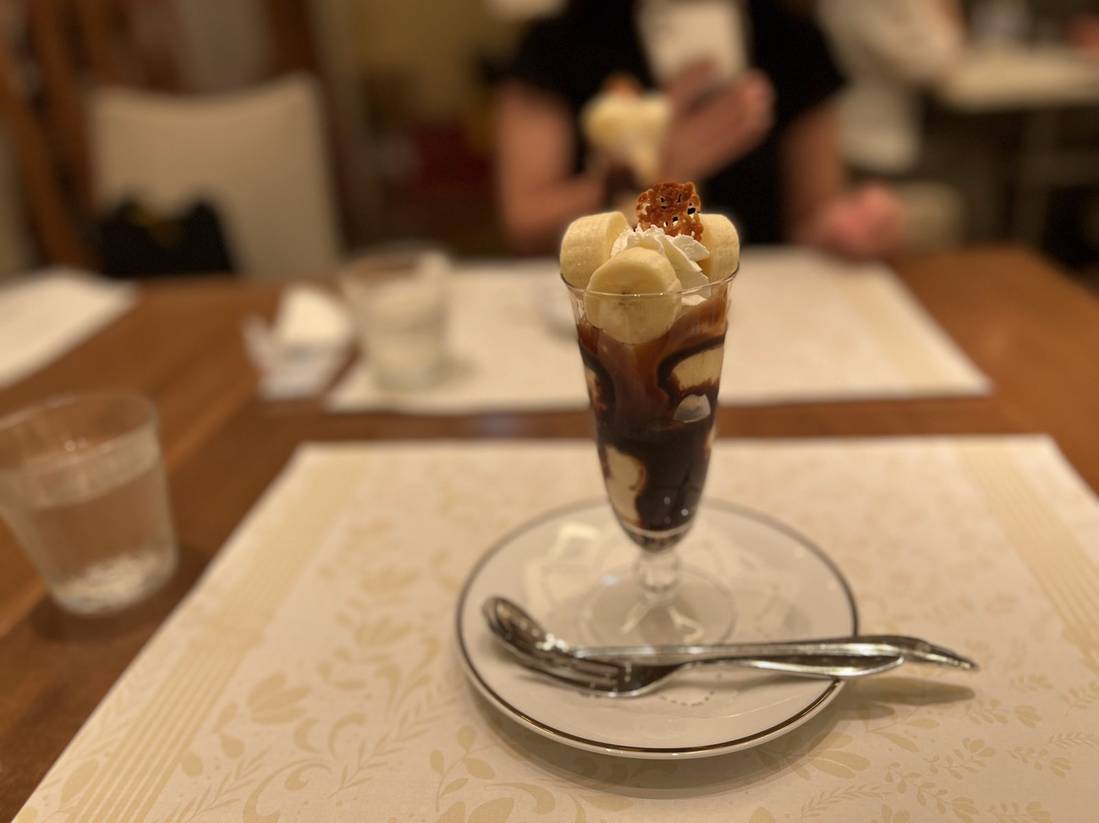
The one we had was a banana parfait: banana, chocolate sauce, whipped cream, and a shard of caramel brittle standing upright out of the top of it. It arrives with a long spoon and a doily under the plate.
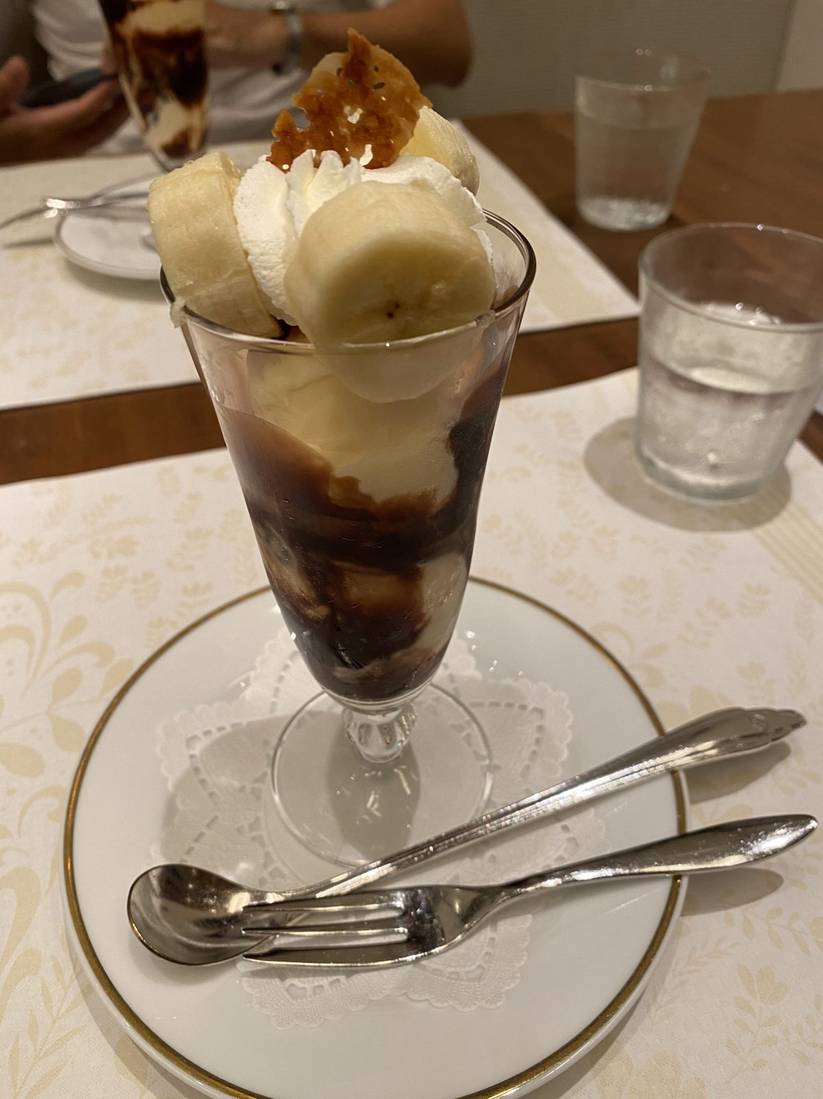
Whatever is on when you go, order one. If two of you split a main and take a parfait each, you have had the correct experience.
Getting there without leaving the station
This is the part worth planning around. The restaurant is on the 12th floor of JR Central Towers, the building directly on top of Nagoya Station. You do not go outside. You do not cross a road.
- Address: 1-1-4 Meieki, Nakamura-ku, Nagoya — JR Central Towers 12F
- Open: 11:00–22:00, last orders 21:30 (courses 21:00). Closed only when the building is
- Reservations: dinner only — they take none for lunch. Weekdays 17:00–20:30, weekends and holidays 18:00–20:30
- Phone: 052-588-2240
Follow the signs for the Towers Plaza restaurant floors — 12 and 13. The lifts you want are past the department store rather than inside it, which is the only genuinely confusing part.
If you are on a Shinkansen transfer: ninety minutes is enough for a main and a coffee. Two hours is enough to do it properly. There are coin lockers on the concourse below you, so the suitcase is not a problem.
Ginza or Nagoya?
The Ginza building is the original and it is a proper occasion — a whole building, several floors, a salon de café on the third for parfaits alone. If you are in Tokyo with a free afternoon and you want the full version, go there.
But most people reading this will pass through Nagoya Station and never through Ginza. The kitchen is the same company, the traditional dishes are the same dishes, and you can be seated eleven minutes after getting off a train.
The Nagoya branch also has things Ginza does not — a weekday lunch plate, a dressed omurice on weekday evenings, and dishes built around Aichi pork. Even a Ginza institution adapts when it moves in down the road from us.
FAQ
Is there an English menu?
The company runs an English site, and the restaurant sits inside a station complex used by international travellers all day. Ask at the desk. Failing that, everything on this page is on the menu by name, and pointing at a photograph has never failed anyone.
Do I need to book?
Not for lunch — they do not take lunch bookings at all. For dinner you can reserve, and on a Saturday evening you probably should.
Is this a good place to bring children?
Yes. There is a kids’ plate at ¥1,870 and a kids’ parfait at ¥1,100, both for primary school age and under. It is a formal room, but not a silent one.
What is the one thing to order if I only have one?
The meat croquette, ¥2,310. It is the dish the restaurant is known for, and it shares nothing with the potato croquette sold in every supermarket in the country.
Is yōshoku the same as fusion food?
No, and it is worth being clear about it. Fusion is deliberate. Yōshoku is what a hundred and twenty years of Japanese cooks quietly adjusting a foreign recipe produced, without anyone setting out to invent a cuisine. Nobody here thinks of curry rice as foreign food any more.
• JR Central Towers 12F, inside Nagoya Station · 11:00–22:00 (L.O. 21:30)
• Hanatsubaki Plate ¥3,850 — prawn fry, meat croquette, hamburg, chicken rice, soup, coffee
• One dish only? Meat croquette ¥2,310
• Seasonal parfait ¥2,640–2,860 · kids’ plate ¥1,870
• No lunch reservations · dinner reservations from 17:00 on weekdays
• Trading since 1902 — Japan’s first soda fountain, in the corner of a Ginza pharmacy
• Prices from the restaurant’s own menu, checked August 2026 · nobody paid us anything · no affiliate links on this page
More from the same station: tonkotsu ramen two floors below, ¥890, why a coffee here comes with breakfast attached, and where to put the suitcase first.