My husband is from Fukuoka. I am from Nagoya. This is his ramen, ordered his way, in my city — and you will not have to say a word.
💴 Cost: standard bowl ¥890 · the set we ordered ¥1,190 · second helping of noodles ¥110
📍 Where: Dai Nagoya Building B1F — underground the whole way from Nagoya Station
⚠️ The catch: none. You order from a screen. The only decision is how firm you want the noodles
Have you heard of tonkotsu ramen?
If you have found your way to this page, there is a good chance you already have. Maybe you have seen the bowl: milk-white soup, thin straight noodles, a slice of pork laid over the top. Maybe someone told you it was the one you had to try in Japan.
They were right.
Tonkotsu is pork bones, boiled hard for hours until the fat breaks apart and turns the water opaque. It does not behave like soup. It coats your mouth. It is rich in a way that is difficult to describe until it is in front of you, and it is the reason people who visit Japan once come back specifically for another bowl.
My husband is from Fukuoka, where this soup was invented. He ate it for the first twenty-two years of his life — never at home, because nobody makes this at home, but in the shops near school, near work, on the way back from anywhere. He thinks that if you come to Japan, you have to eat this. Not should. Have to.
The problem is where it lives. Real Hakata tonkotsu is from Fukuoka, on the island of Kyushu — five hours from Tokyo by bullet train, and not on most people’s route. Flying down for one bowl is a lot to ask.
So this page is about the other option: eating it properly, somewhere you were going anyway.
We found a Hakata-style shop in the basement next to Nagoya Station. He ordered exactly the way he would at home, and I wrote down every single thing he did — because watching him, I realised how much of it nobody tells you.
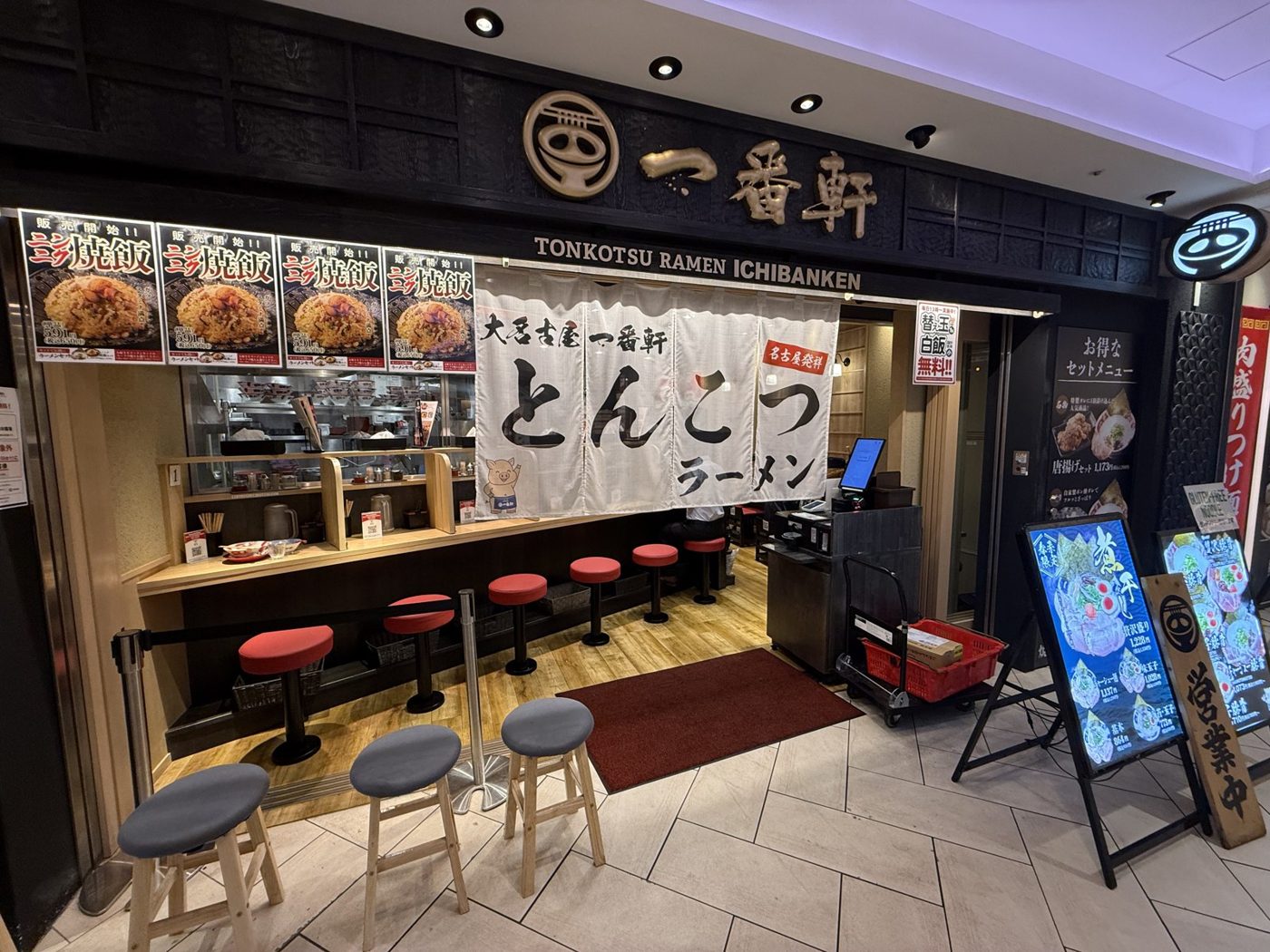
Here is where people get stuck:
- The menu is in Japanese and nobody will speak English
- They are going to ask you a question at the counter and you will not understand it
- There is a jar of something red on the table and you do not know if you are allowed to touch it
- Everyone else clearly knows something you do not
- You have heard the soup smells strong, and you are not sure you want that
- You will do something wrong and someone will notice
Every one of those has an answer. Here they all are, before you walk in.
The short version
- Scan the QR code at your seat. No Japanese needed
- Ask for barikata — thin noodles soften as you eat
- Beni-shoga in at the start. Check the takana for red chilli before you decide when to add it
- Order kaedama when half your noodles are gone, and tip it in the moment it lands
- After 13:00, one kaedama or one bowl of rice is free
- Finish the soup if you want to see what is printed underneath — but it is salty, and you do not have to
- On your way out, carry the bowl over and say gochisousama deshita
The rest of this page is why.
You order from your phone, and it speaks English
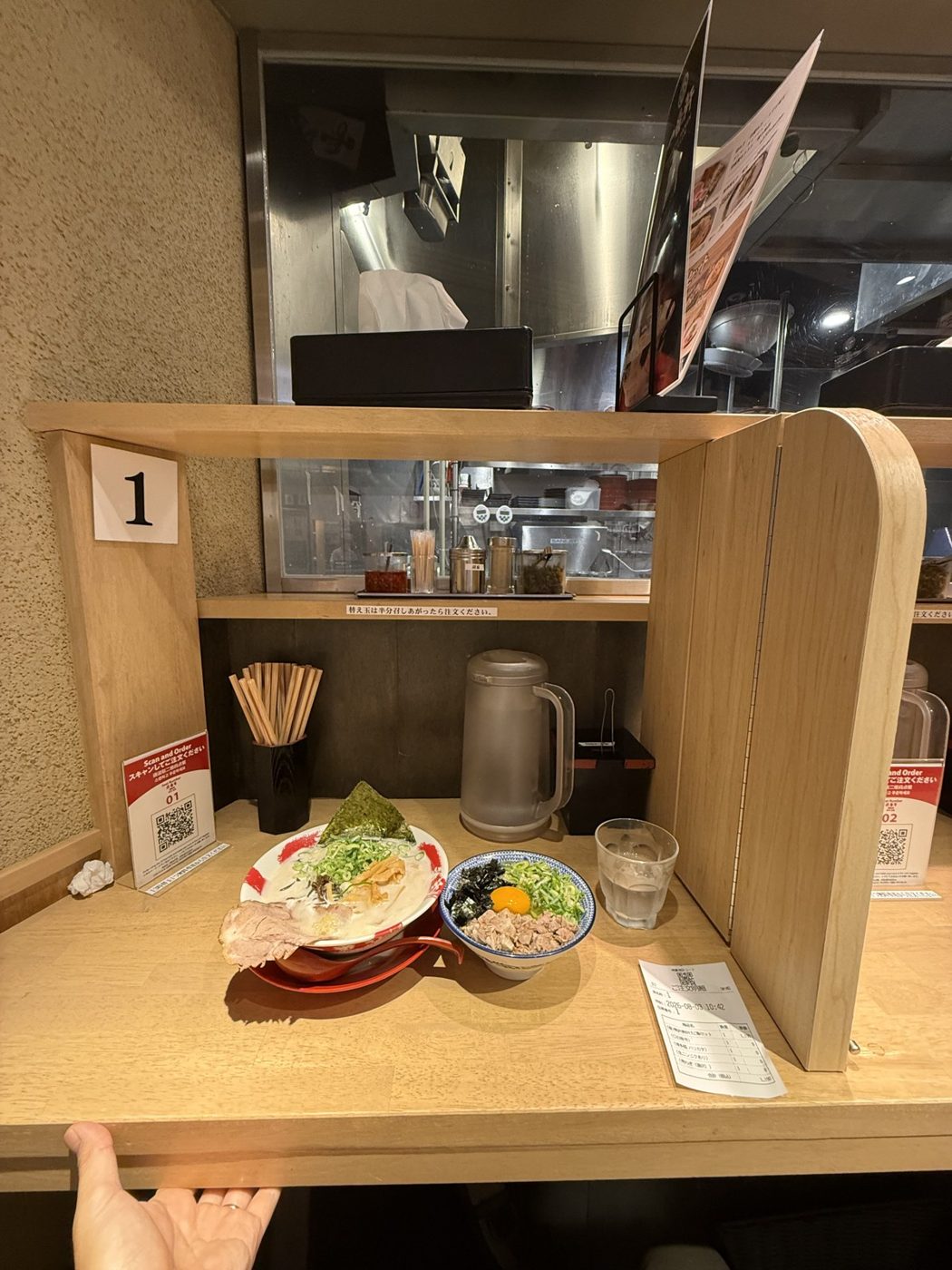
At this shop you do not speak at all. There is a QR code standing on the counter at your seat, with your seat number printed on it. You scan it with your phone, order on your own screen, and pay at the register when you leave.
The ordering screen is in Japanese, English, Chinese and Korean.
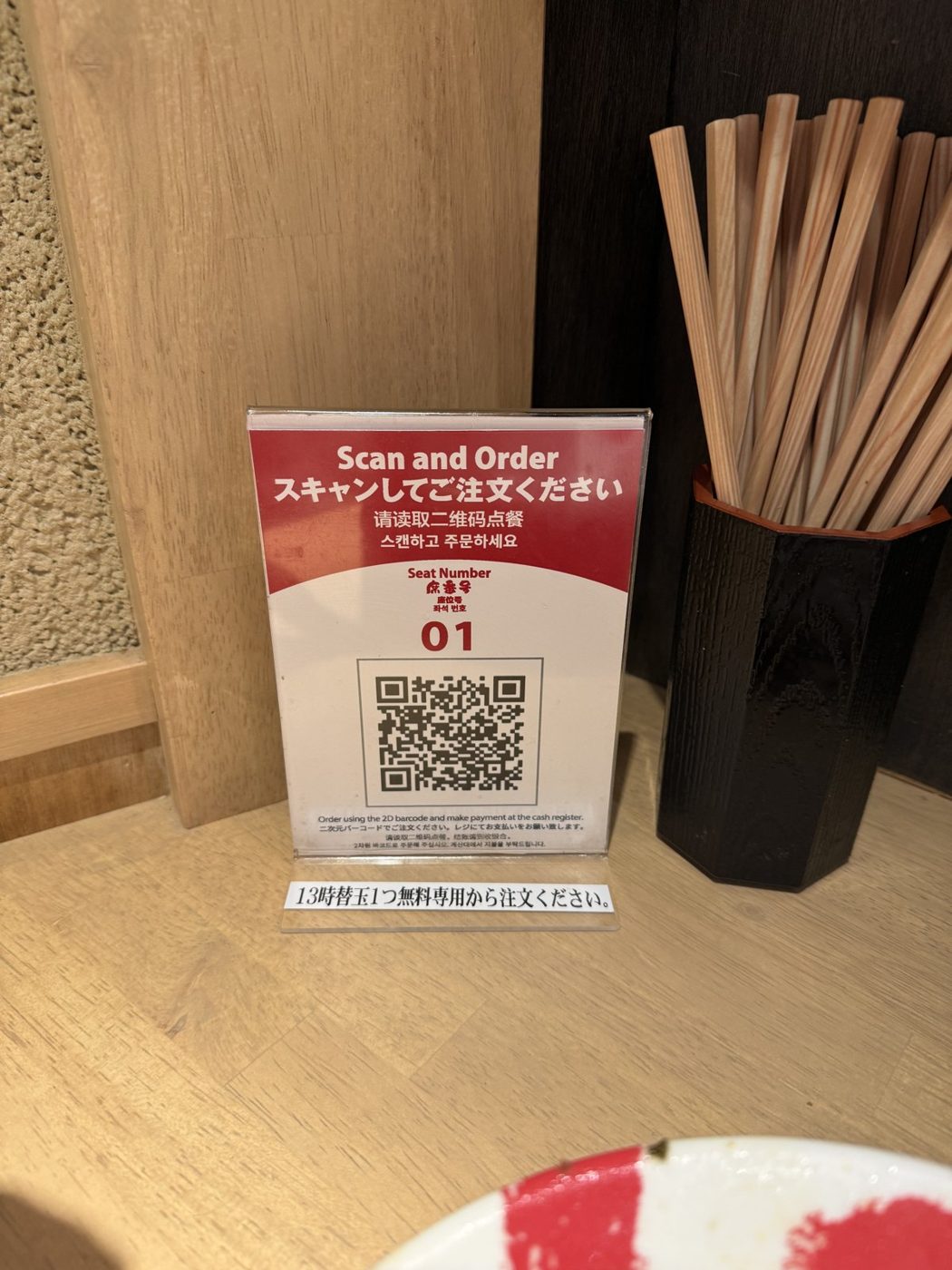
This is now normal in a lot of Japanese ramen shops, in one of three forms: a QR code like this one, a ticket machine by the door, or ordering out loud at the counter. If it is a ticket machine, look for the photos and press the top-left button — that is almost always the shop’s standard bowl.
The one question they will ask you
They are. It is this one: how firm do you want the noodles?
In most of Japan this is a minor preference. In Fukuoka it is a whole vocabulary, and the answer you give is the first thing that tells the shop whether you have done this before.
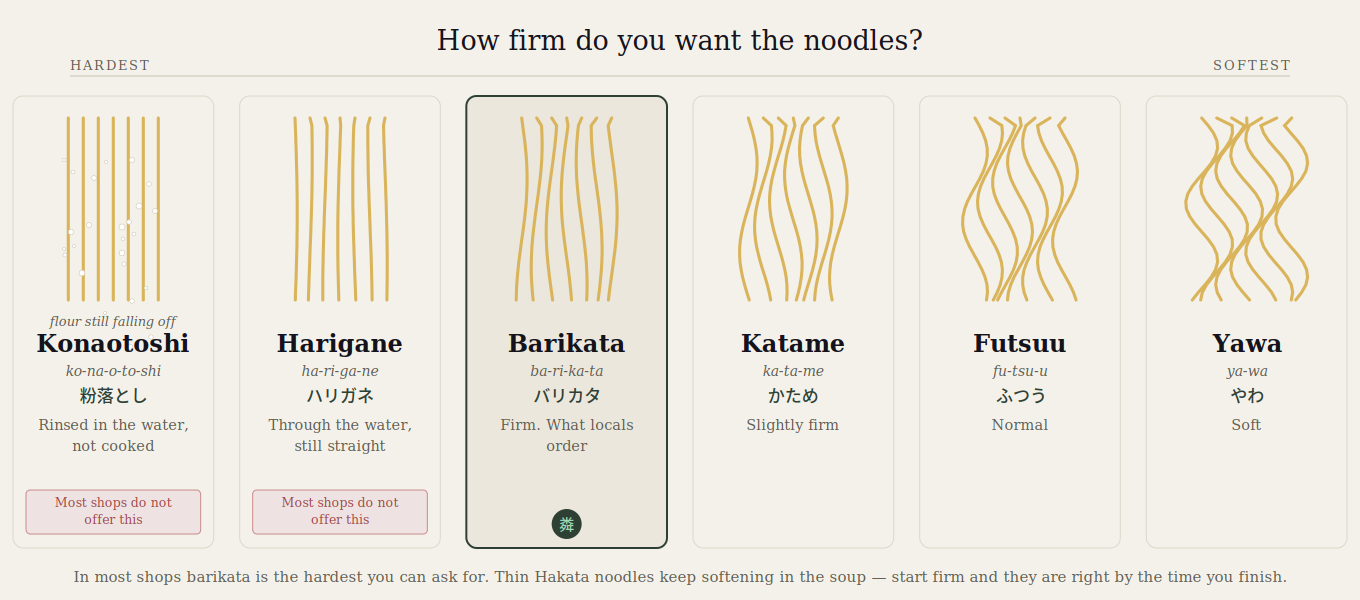
Here is the part nobody explains, and it is the whole reason the vocabulary exists: Hakata noodles are very thin, so they keep softening in the soup while you eat. If you start at barikata, by the time you reach the bottom of the bowl they have relaxed to about normal. If you start at normal, you finish on mush.
Barikata is not bravado. It is timing.
 IKI STYLE
the Japanese idea of cool
Say "barikata" and nothing else. No hesitation, no question mark at the end. One word. The staff will not react, which is the point — you have just ordered the way half of Fukuoka orders. If it is your first bowl in Japan and you want to hedge, say katame instead. Do not order konaotoshi to prove something.
The bowl is small on purpose
It is small. That is on purpose, and it is the same reason the noodles are thin.
People in Fukuoka are impatient. That is my husband’s explanation and it is the real one. Thin noodles cook in seconds, so a shop can put a bowl in front of you almost immediately. In a city where lunch is short, thin noodles win.
But thin noodles mean a small portion. So Hakata invented the fix: kaedama — a second helping of noodles, cheap or free, that turns a small bowl into a full meal. At this shop it is 110 yen, and free after 13:00.
Kaedama is not a challenge. It is not an upgrade. It is how the bowl is supposed to work. Most locals order one without thinking about it.
Kaedama: ask when half the noodles are gone
Order it when about half the noodles in your bowl are gone.
This is the single most useful thing on this page, and it is worth understanding why, because the reason is not obvious.
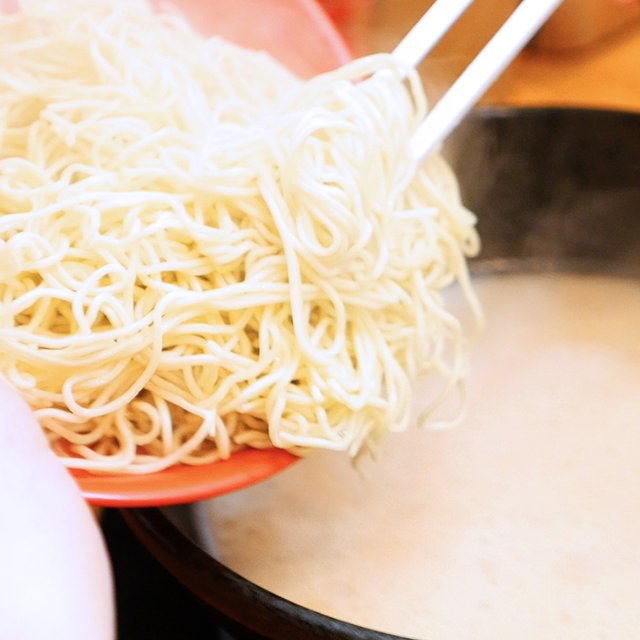
Kaedama does not arrive in soup. It arrives as a small plate or bowl of bare boiled noodles, nothing else. You tip them into the soup you already have.
Which means the clock is running from the moment it reaches you. Leave those bare noodles sitting on the plate and they cool down, dry at the edges and clump into a solid lump. Once they clump, they do not come apart properly in the soup.
So the timing works like this:
- Half a bowl left — the kitchen takes a minute or so to boil the next batch, and it lands just as you finish the first lot. You tip it straight in. Perfect.
- Too early — the plate arrives while you still have plenty of noodles, and sits there going cold and sticky while you catch up.
- Too late — you are sitting in front of a bowl of soup with nothing in it, waiting.
At this shop it is written on the wall, in Japanese, above the counter. Most shops do not tell you.
 TSŪ INFORMATION
what Japanese connoisseurs know
Tip the noodles in the second the plate lands, then eat. Do not photograph it, do not admire it. The kaedama arrives dry and is already on a timer — half the reason locals look fast is that they know it. If you want a second kaedama, order it at the same point again: halfway through the new lot.
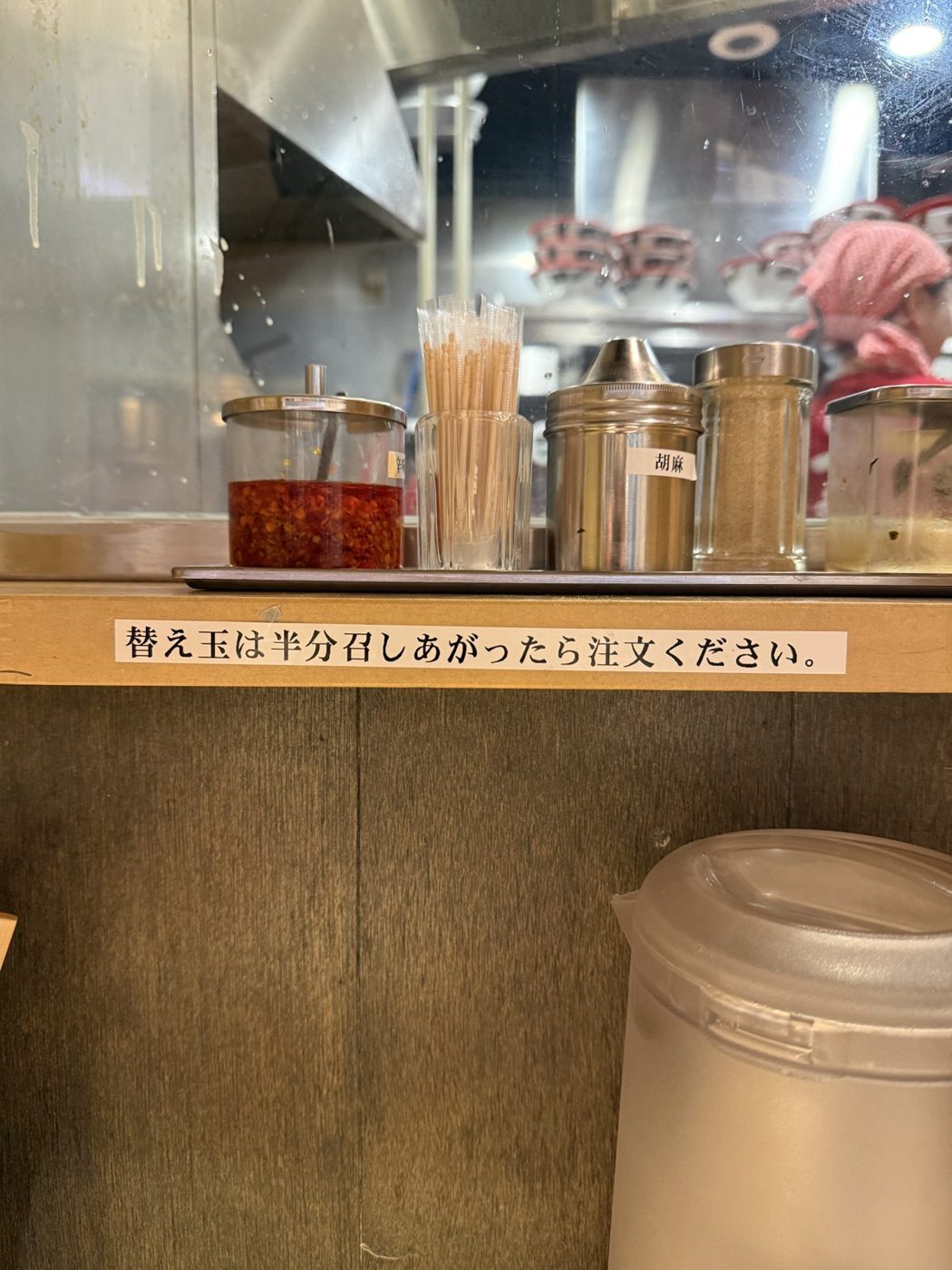
The two jars on the counter are free
Yes. They are free, they are on the table for you, and helping yourself is part of eating the bowl — not a bonus, not something you are getting away with.
There are two, and both will probably be unfamiliar.
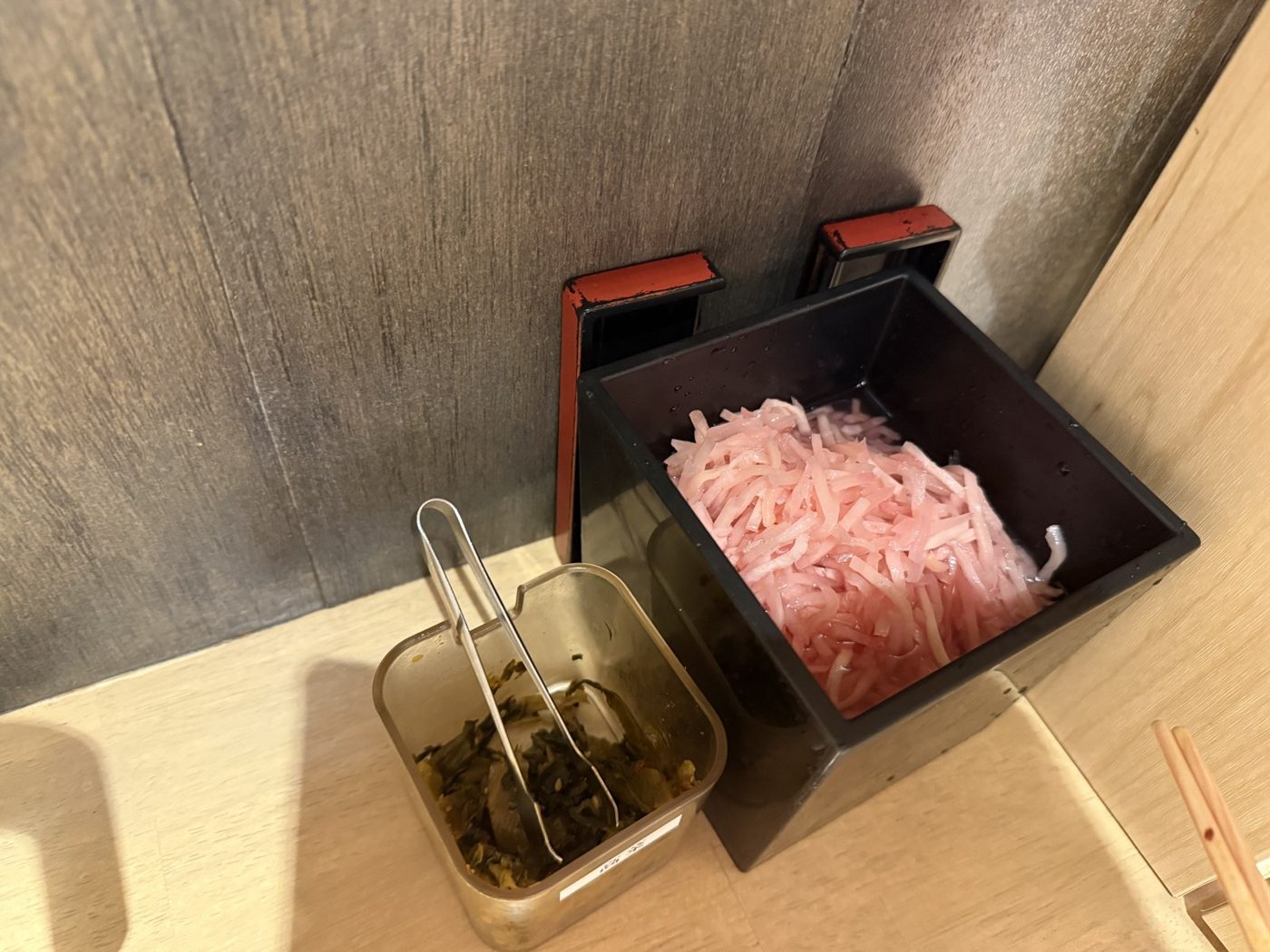
Beni-shoga is ginger, cut into fine threads and dyed bright pink. Japan uses it everywhere — on rice bowls, on okonomiyaki, in yakisoba — for two reasons: it looks good against brown and white food, and it resets your mouth. Anything rich, fatty or strong tends to arrive with beni-shoga beside it. Every gyudon (beef bowl) shop in the country keeps a pot of it on the table.
Takana is a Japanese leaf vegetable, pickled and seasoned. Technically a vegetable, but do not think of it as one — the seasoning is the point, not the greens.
If it helps: think of both as pickles. That is the job they are doing. Sharp, salty, sour, there to cut through a heavy bowl.
Beni-shoga goes in at the start. Always. My husband does not think about this one. The sharpness cuts the pork fat from the first mouthful, and it is part of the flavour the bowl is built around.
Takana is the one that needs a decision, because the heat varies a lot from shop to shop. Some shops put out plain pickled greens with no chilli at all. Some put out karashi-takana, which is properly hot.
Judge it by the red. Look at the container before you take any. If you can see a lot of red chilli through the greens, it is hot. If it looks green-brown with barely any red, it is mild.
- Mild — put it in at the start, with the ginger
- Hot — this is where it gets interesting. Eat the first half of the bowl as it comes, then stir the takana in and eat the second half. The shop puts it there for exactly this. You get two bowls out of one: clean tonkotsu first, then a hot, sharp version of the same soup. If you like heat, this is the best five seconds of the meal
That is exactly what my husband did here. He looked at the container, saw very little red, and spooned it straight in.
Free after 13:00, and nothing tells you in English
At this shop, yes, and it is worth timing your visit around.
Every day from 13:00, you get either one kaedama or one small bowl of rice, free. One or the other, not both. 100 g either way. Mini ramen is excluded.
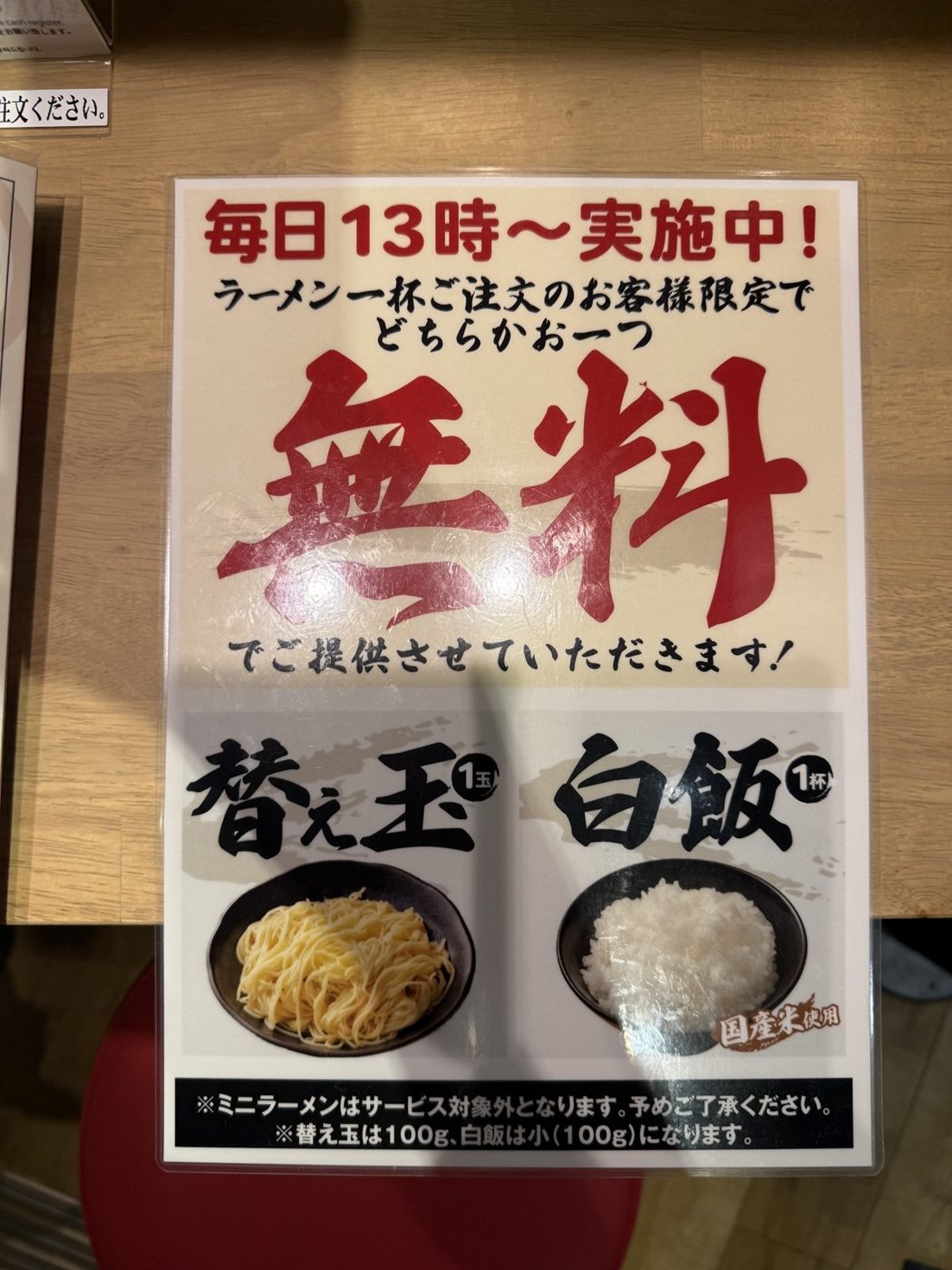
You order it through the same QR screen, from a separate free-items section. If you turn up at 13:05 instead of 12:45, your lunch is cheaper for no extra effort.
Offers like this come and go, so treat it as a reason to check rather than a guarantee — it was running when we visited in August 2026.
Finishing the soup, and one honest warning
In Fukuoka, finishing the soup is what you do when the ramen was good. It is not required and nobody is watching. But it is the clearest thing you can say without saying anything.
And a lot of shops reward you for it. Many tonkotsu shops print something on the inside bottom of the bowl — a line you can only read once the soup is gone. Very often it just says ありがとう (arigatou, thank you). Some shops write something longer.
At this shop, what appeared was the shop’s own mark and the year it opened.
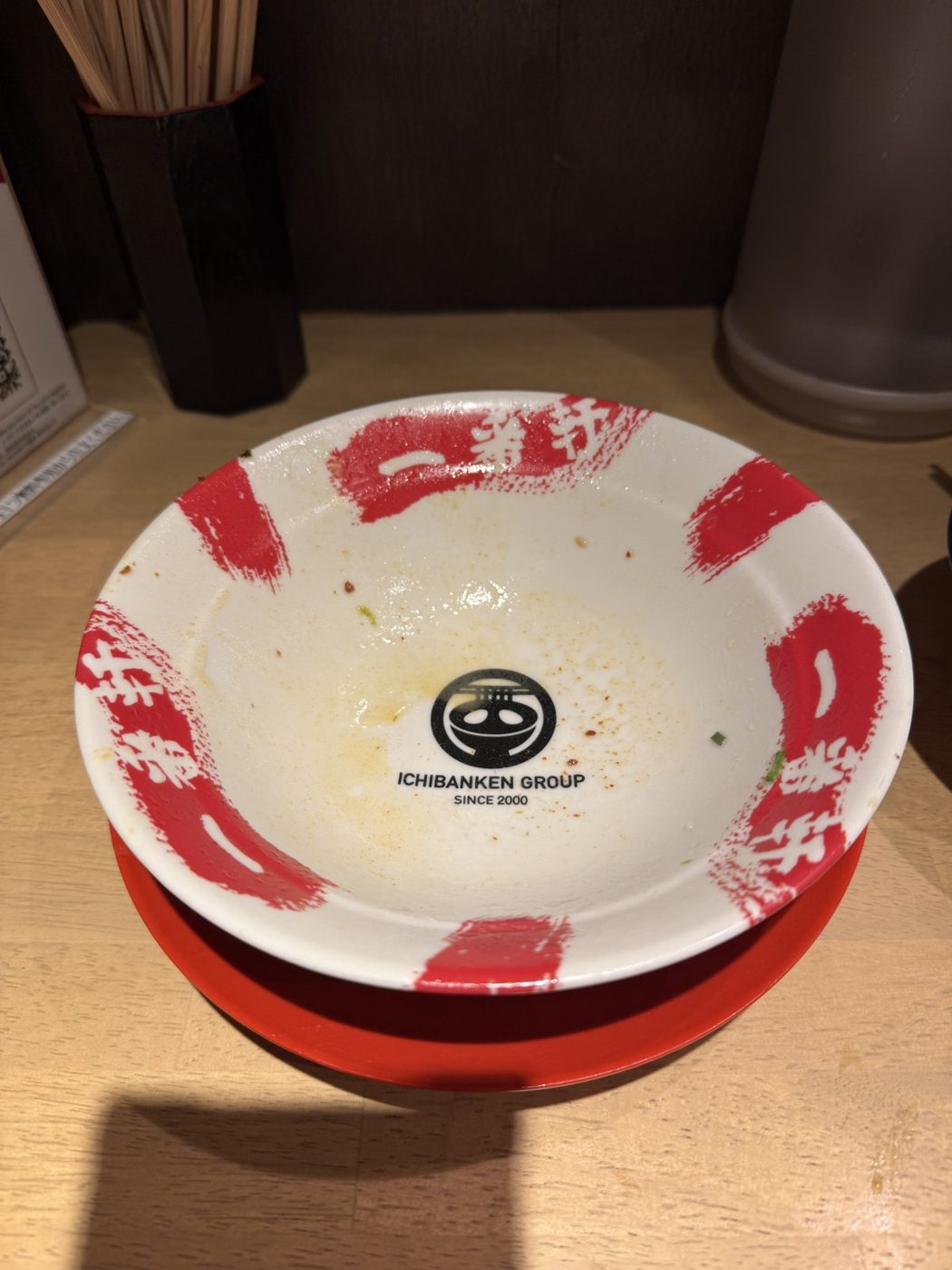
It is a small thing and it is only for the person who got to the bottom. Once you know it is there, you will want to look.
One honest warning, and please take it seriously. Tonkotsu soup is very salty. A whole bowl of it is a lot of sodium in one sitting. If you have blood pressure to think about, or you are simply being careful, leave the soup. Nobody will think less of you and my husband would tell you the same. Whatever is printed on the bottom of the bowl is not worth your health.
What to do when you stand up
This is the one that surprised me most, and in Kyushu it is completely ordinary.
On your way out — not before — carry your bowl to the counter or the return stand, put it down, and say “gochisousama deshita”.
The reasoning is practical, and once you hear it you will understand a lot about how ramen shops work in Japan. A ramen shop lives on turnover: feeding as many people as possible, fast, at a low price. The slowest part is clearing tables. When you carry your own bowl over, you take one step out of that loop.
You are not being polite to the staff. You are helping the next person get their lunch.
One honest note, because this matters: no shop asks you to do this, and it is not a rule anywhere in Japan. Some shops would rather you left the bowl where it is. Look for a return stand or a gap on the counter. If there is no obvious place, leave it on the table and walk out — that is completely fine, and it is what we did here, because this shop has nowhere to put it.
IKI STYLEthe Japanese idea of cool
Stand up, take the bowl, say it once on your way past. Not a bow, not a speech. You pick the bowl up as you stand, walk it to the counter, set it down, say gochisousama deshita without stopping, and keep going. My husband says it is the single easiest thing a visitor can do that genuinely makes a shop happy.
If there is nowhere obvious to put it, leave it on the table — that is not a failure. This shop had no return counter, so we left ours where they were. But look first.
The one thing not to do
There is almost nothing you can get wrong in a ramen shop. Slurping is fine. Eating fast is fine. Eating alone is completely normal. Using your phone is fine.
The one thing my husband would ask: do not leave the counter swimming in soup.
Tonkotsu is a fatty soup and splashes do not come off in one wipe. Somebody has to clean it properly, and while they are cleaning, that seat is not available. Same logic as carrying your bowl over. Small mess, real cost, and the person who pays it is whoever is next in line.
Show this to the staff
You will not need any of these at this shop, because you order on your phone. At a counter shop in Fukuoka, these six cover almost everything.
| バリカタで | barikata de | Firm noodles, please |
| 替え玉お願いします | kaedama onegai shimasu | Extra noodles, please |
| おすすめは何ですか | osusume wa nan desu ka | What do you recommend? |
| これは辛いですか | kore wa karai desu ka | Is this spicy? (point at the takana) |
| 一人です | hitori desu | Just one person |
| ごちそうさまでした | gochisousama deshita | Thank you for the meal (on your way out) |
What a Fukuoka native thought of this bowl
His verdict, in his own words: the smell was clean.
Real Hakata tonkotsu has a funk to it — a strong pork-bone smell that reaches you before the bowl does. If you grew up with it, that is the smell of home. My husband likes it, and he will tell you a shop without it is missing something.
But he also knows most people do not like it, and that plenty of visitors take one breath, decide tonkotsu is not for them, and never try again.
This bowl tasted like proper tonkotsu and barely smelled of anything. The soup is boiled from thirty-five pigs’ worth of bones and the shop uses only the first extraction, never a reboiled stock. That is where the cleanness comes from.
So the recommendation is a specific one, and it is worth more coming from someone who actually prefers the funk: if the smell is what put you off tonkotsu, this is the bowl to try. All of the flavour is there. The part that scares people off is not.
What it costs
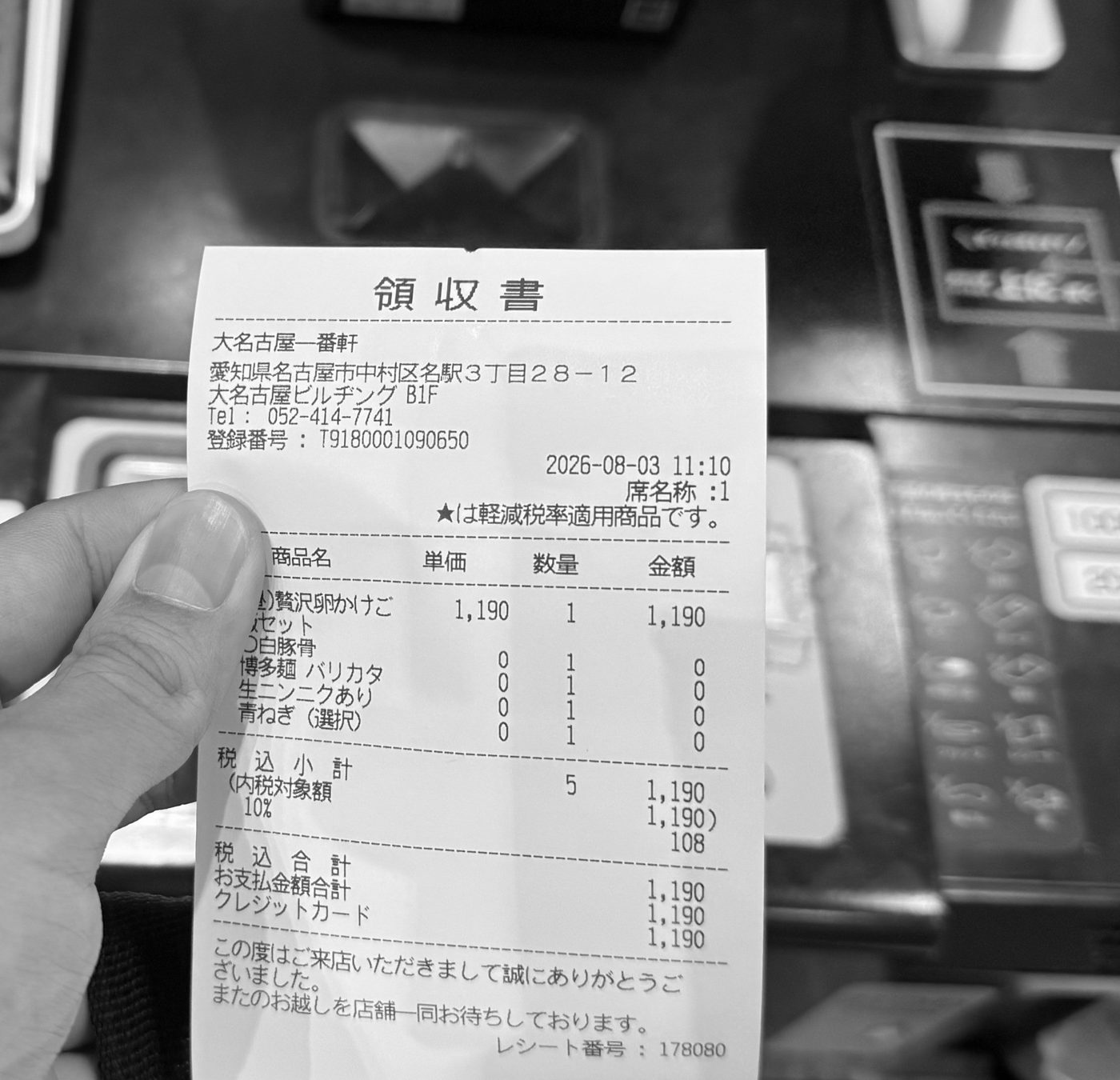
Every price here was read off the menu on the table in front of us and paid on our own card. Tax-included prices are what you actually hand over.
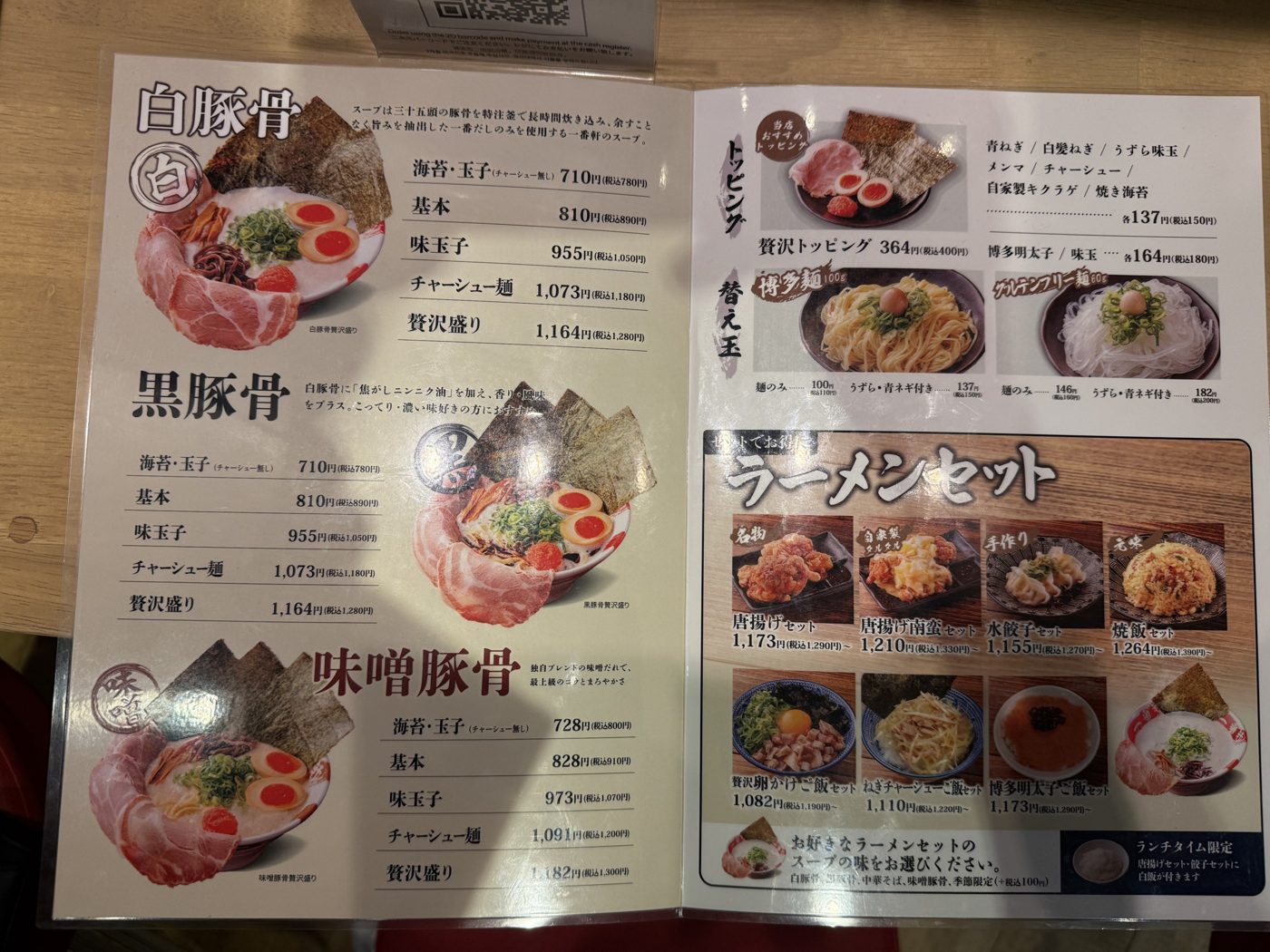
Shiro tonkotsu (white — the classic) and kuro tonkotsu (black — the same soup plus burnt garlic oil) cost the same:
| Tax-excl. | You pay | |
|---|---|---|
| Nori & egg (no chashu) | ¥710 | ¥780 |
| Standard | ¥810 | ¥890 |
| With seasoned egg | ¥955 | ¥1,050 |
| Chashu-men (extra pork) | ¥1,073 | ¥1,180 |
| Zeitaku-mori (everything) | ¥1,164 | ¥1,280 |
Miso tonkotsu runs slightly higher: ¥800 / ¥910 / ¥1,070 / ¥1,200 / ¥1,300.
| Kaedama (extra noodles) | You pay |
|---|---|
| Hakata noodles, 100 g — noodles only | ¥110 |
| Hakata noodles, with quail egg & spring onion | ¥150 |
| Gluten-free noodles, 60 g — noodles only | ¥160 |
| Gluten-free, with quail egg & spring onion | ¥200 |
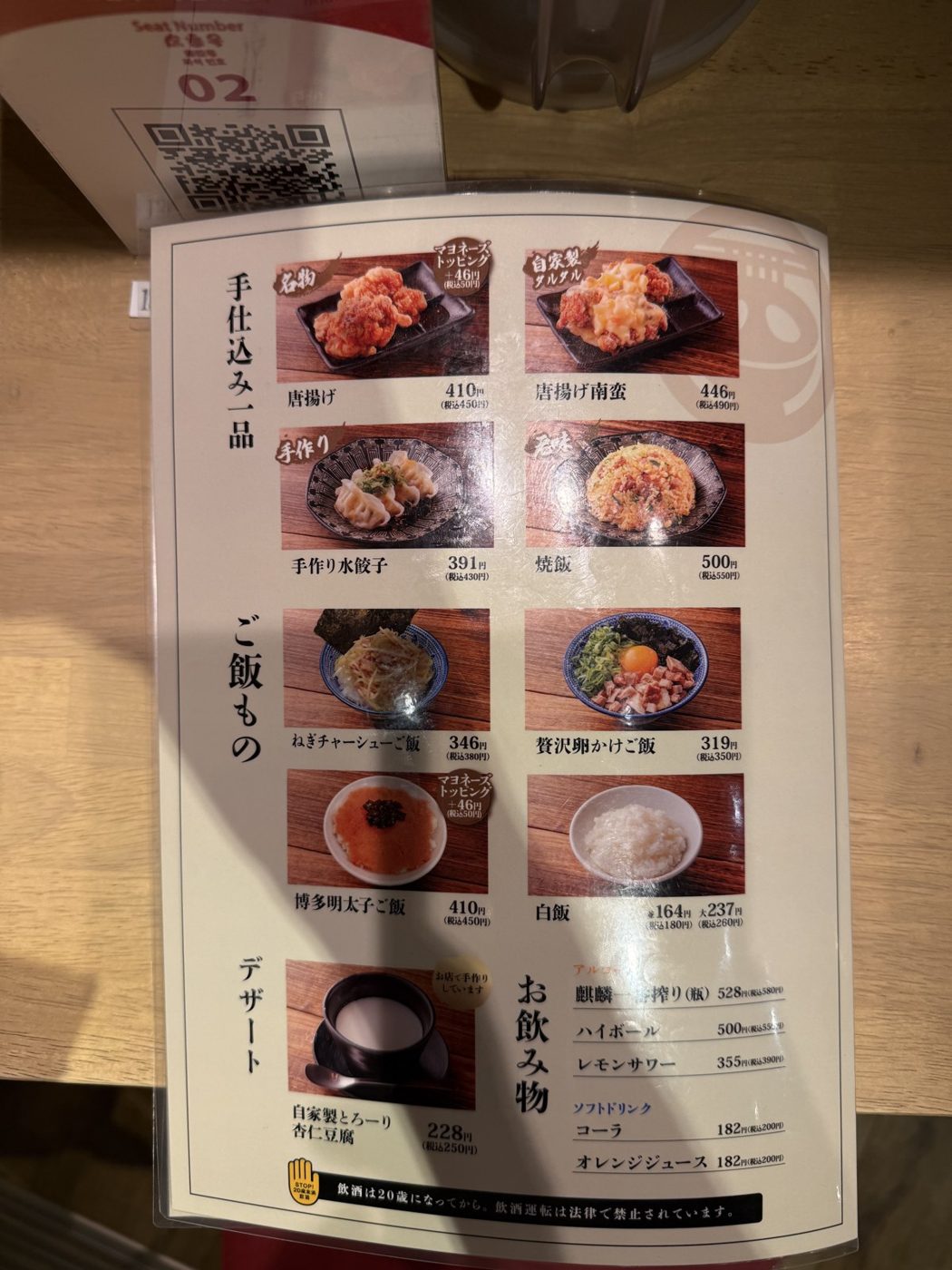
| Sides and rice | You pay |
|---|---|
| Karaage (fried chicken, the house speciality) | ¥450 |
| with mayonnaise | +¥50 |
| Karaage nanban, house tartare | ¥490 |
| Hand-made boiled gyoza | ¥430 |
| Fried rice | ¥550 |
| Spring onion & chashu rice bowl | ¥380 |
| Raw egg rice bowl with chashu | ¥350 |
Toppings are ¥150 each: spring onion, white onion, quail egg, menma, chashu, house wood-ear mushroom, roasted nori. Hakata mentaiko or a seasoned egg is ¥180.
Sets (a bowl of ramen plus a rice bowl or a side) start at ¥1,190. We paid ¥1,190 for the raw-egg rice bowl set with shiro tonkotsu, barikata.
Quick facts
| Shop | Dai-Nagoya Ichibanken (大名古屋一番輱) |
| Where | Dai Nagoya Building B1F, 3-28-12 Meieki, Nakamura-ku, Nagoya |
| Getting there | Underground from Nagoya Station, about two minutes |
| Ordering | QR code at your seat. Japanese, English, Chinese, Korean |
| Paying | Cards accepted. We paid by card |
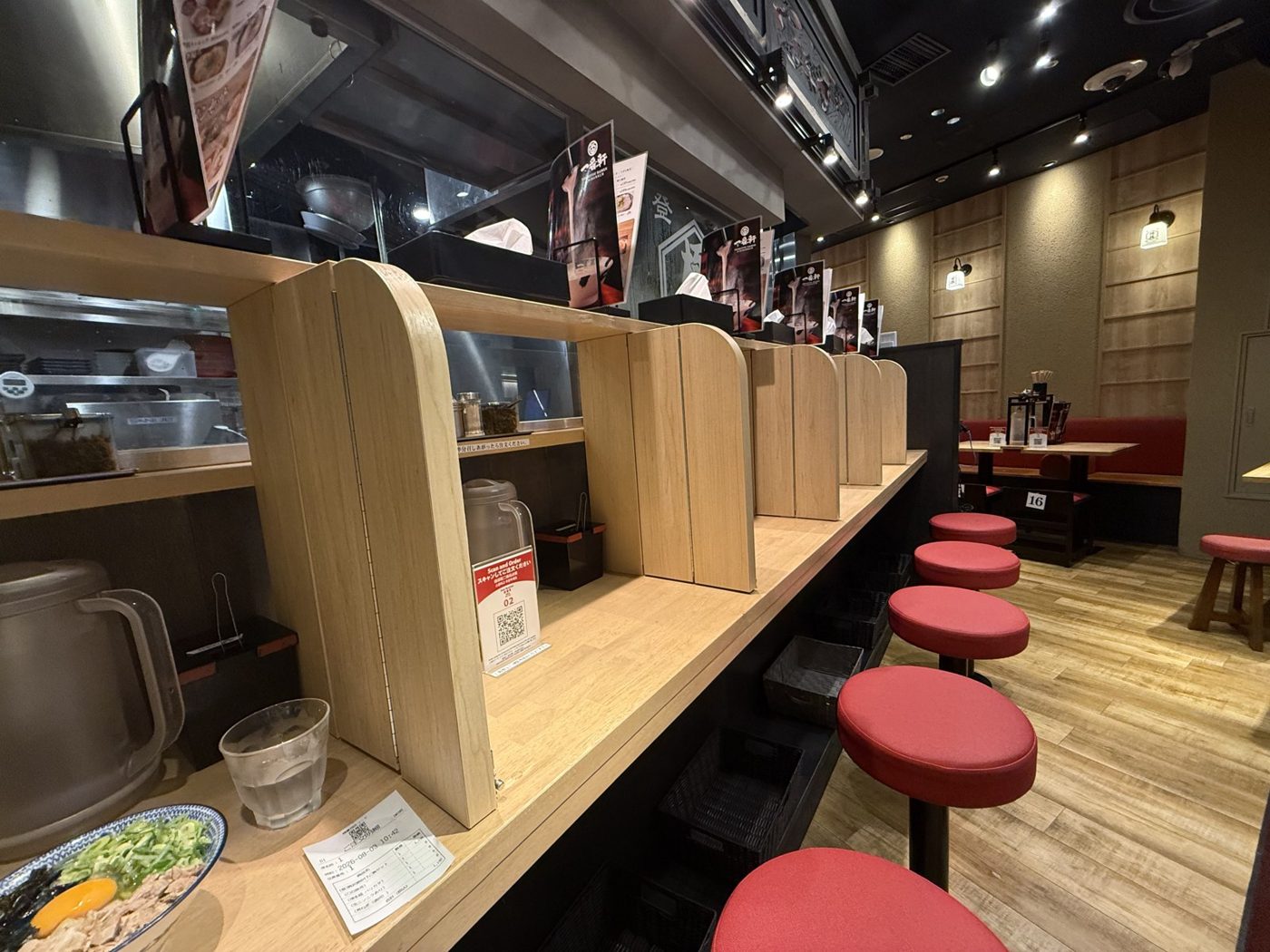
| Seating | Single seats with wooden dividers, plus normal tables at the back |
| Gluten-free | Yes — gluten-free noodles on the menu. Rare in ramen shops |
| Visited | 3 August 2026, 11:10 |
FAQ
Can I go in alone?
Yes, and plenty of people do. Eating ramen alone is completely ordinary in Japan — at lunchtime most of the counter is people on their own. The divider seats at this shop exist precisely because so many people come alone.
Can I bring children?
Yes. Ramen shops with children in them are common, and this one has normal tables at the back as well as the counter seats.
Is there a gluten-free option?
At this shop, yes — gluten-free noodles are on the menu at ¥160. This is rare. Most ramen shops have no gluten-free option at all, so do not assume it anywhere else. Note that the soup and toppings are not certified gluten-free; if you are coeliac rather than avoiding gluten by choice, ask before you order.
Is the free kaedama after 13:00 available to everyone?
Yes, anyone can take it — no membership, no app. It was running in August 2026. Offers like this are not permanent, so treat it as a bonus rather than a plan.
What if I do not want the extra noodles?
Then do not order them. Nobody expects you to. A single bowl is a normal lunch.
Do I have to slurp?
No. Slurping is fine and normal, and nobody minds if you do not.
What is the difference between shiro and kuro?
Kuro is the same soup with burnt garlic oil stirred in — darker, heavier, more aroma. If it is your first tonkotsu, start with shiro. You can taste what the soup actually is.
• Scan the QR on your seat · the screen has English, Chinese and Korean
• Say barikata — the noodles soften in the soup as you eat
• Red ginger in at the start · taste the mustard greens first, then decide
• Order kaedama when half the noodles are gone, not when you finish
• After 13:00: one kaedama or one small rice, free — mini ramen excluded
• Standard bowl ¥890 · our set ¥1,190 · visited 3 August 2026, 11:10
• We paid for our own lunch · nobody paid us anything · no affiliate links on this page
More from the same city: the Osu neighbourhood on foot and the pizza counter we go to when we want to celebrate a Tuesday.
Before the ramen, there was breakfast: in this city a coffee comes with toast and an egg, free, until 11:00.