I got as far as the lobby, took the menu, read it twice and walked back out. So here is what I found out, to save you the homework.
Budget: an entry charge, plus drinks from ¥720 or food at ¥1,250 on the menu we photographed
Where: at-home cafe Nagoya Osu, Hills Osu 1F–3F, 3-10-19 Osu, Naka-ku · 5 min from Kamimaezu station
Difficulty: logistically none. Emotionally, it depends on you
1. A maid café is themed hospitality: staff in maid outfits greet you as the master or princess of the house. It is a performance, and everyone knows it
2. at-home cafe is the Akihabara chain that has been running since 2004. The Osu branch opened on 10 May 2025, on Japan’s “Maid Day”
3. You pay an admission fee on top of food and drink, and one seating is one hour
4. The rule that catches everyone: you may photograph your food, not the maids. Photos with a maid exist, but only as a paid Polaroid
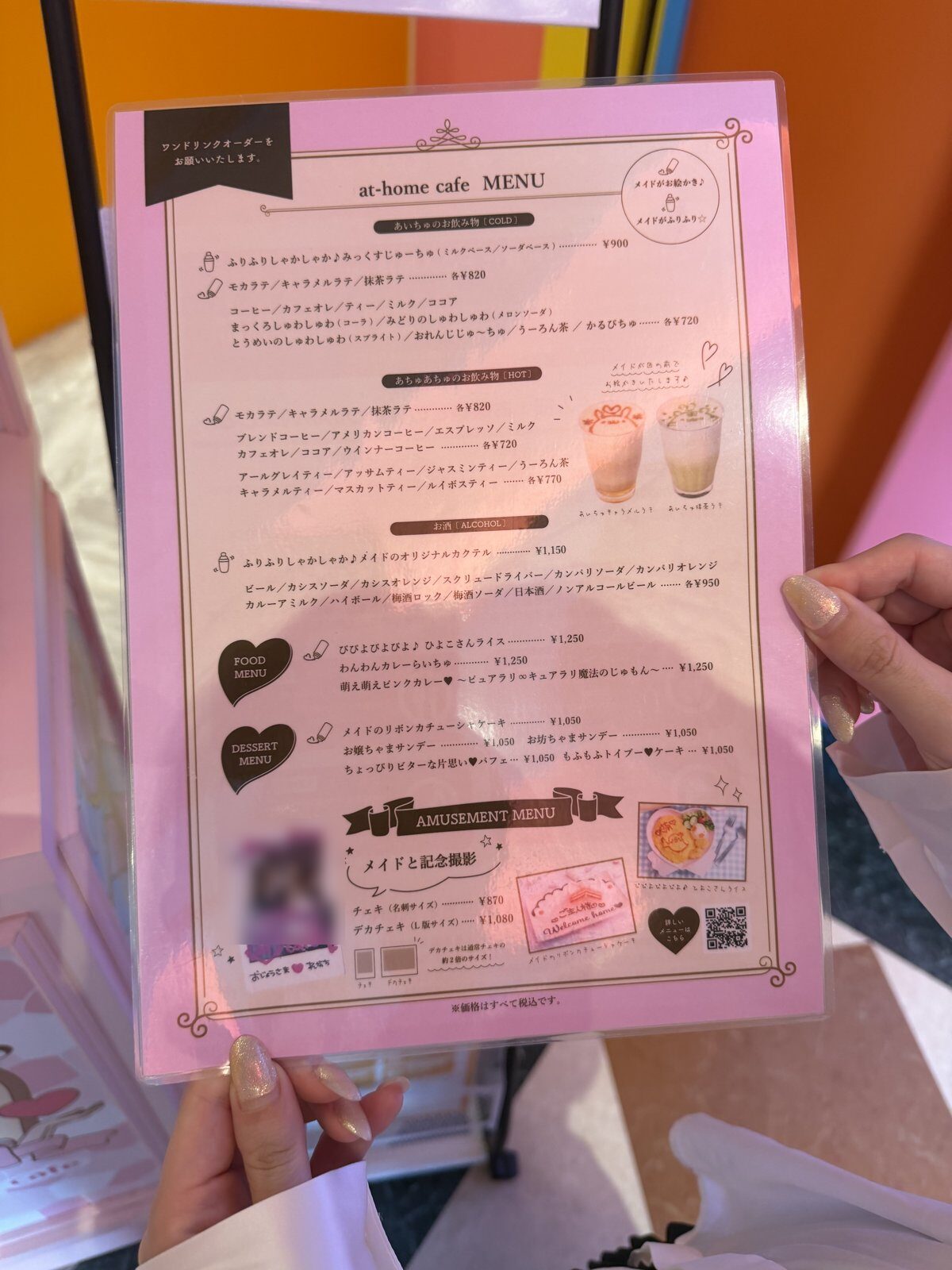
First, a disclosure, because this blog is not worth much without it: I did not actually sit down. I went in as far as the lobby: checkerboard floor, chandelier, a screen counting down the wait for each building, and a self-service terminal where first-timers tap in to get an entry ticket. A member of staff handed me the menu and a one-page sheet of house rules. I read both, looked at the staircase, and left. So this is not a review of the food. It is the briefing I wish I had read before I got that far: the official prices, the rules I was given at the door, and what Japanese first-timers say happens once you go up those stairs.
What it actually costs
- Admission (they call it “rent”): an entry charge per person, before you order anything. at-home cafe changed its prices in 2025, so check their current price list before you go.
- À la carte: drinks ¥720–900, the character rice and curry dishes ¥1,250, desserts ¥1,050 .
- Courses, which are the sane option: drink, dessert, food and full sets, priced on the same current list. Japanese first-timers are usually pointed to the drink course.
- Cheki (the Polaroid): ¥870 for the standard size and ¥1,080 for the large one, from the menu we photographed. The maid decorates it by hand afterwards. Cap: two maids, two shots each per visit.
What happens inside, according to people who went
The lobby screen on the day we went was quoting 30 minutes for one building and 18 for the other, so at a weekend you should not expect to walk in and sit down. Past the terminal, every Japanese account I read describes the same order of things. A maid appears on the entrance screen with okaerinasaimase (“welcome home”) and you are walked upstairs. Near the start comes the moe no chikai, a short vow the maid recites promising to serve you well, and you are given a nickname on the spot. When your drink arrives there is the aikome ritual: hands in a heart shape, a chant, and the instruction to do it loudly, because half-hearted love does not flavor anything. One Nagoya reporter was told exactly that, did it, and said afterwards the drink tasted like magic. I cannot tell you if that was the caramel or the effort.
 TSŪ INFORMATION
what Japanese connoisseurs know
Maid cafés are not about flirting or dating. The industry word is iyashi, healing. The genre started in Akihabara in the early 2000s out of game and anime culture, and at-home cafe (2004) is one of the reasons it stayed respectable: strict rules against touching, private contact and photographing the staff keep the fantasy safe for everyone, and for the maids first. The 通 detail worth knowing: 10 May is Maid Day in Japan, a pun on the numbers 5 and 10, and at-home cafe chose that date to open the Nagoya branch. Over 240 people came the first day and the wait hit three hours. The brand was marking its 20th anniversary when we visited. There is a poster about it in the lobby, and that was when I realised this place is an institution and not a novelty.
The rules, plainly
- Photograph food only, and ask first. No photos or video of the maids, no selfies with them. The cheki is the sanctioned exception.
- No touching, and no contact outside the café. The whole industry depends on this rule.
- One hour per seating. You cannot simply extend; you re-enter as a new session if there is room.
- English: every maid gets English training when she joins, and the menus are visual. Some maids speak more English than others, but all of them will try.
Should you go?
My take, with the obvious caveat attached: go once, and go for the performance, not the meal. Every account says the food is fine and priced for the show around it, so think of the bill as a small theatre ticket. The downsides are the ones that stopped me in the lobby: the hour is short, the entry fee means you cannot just take a quick look, the wait can run half an hour, and if other people’s embarrassment makes you squirm, this will be hard for you, chandelier and all. I am telling you to be braver than I was, which I know is a weak position to argue from.
Map: at-home cafe Nagoya Osu on Google Maps
FAQ
Is it appropriate for couples? For women?
Yes on both counts. The greeting covers goshujin-sama and ojō-sama (master and princess), and women and couples are ordinary customers here. The whole format is meant to be as wholesome as a family theme park.
Do I need Japanese?
No. The menus are photographic, the maids are trained in English, and the chants come with hand gestures you copy. Nobody expects you to be good at it.
Akihabara or the Osu branch?
Same company, same manual, and the Osu one is newer and less crowded. If Nagoya is on your route, fold it into a full Osu afternoon rather than making an Akihabara pilgrimage for it.
• Maid café = theatrical hospitality, born in Akihabara, wholesome by rule-book
• at-home cafe Osu: Hills Osu 1F–3F, 5 min from Kamimaezu · opened 10 May 2025
• entry charge + a drink or set · one hour per seating
• Food photos only: a photo with a maid means buying the cheki (¥870–1,080)
• Written from the lobby, the menu they handed me, official prices and Japanese reports · nobody paid us anything
More from us: the rest of that afternoon lives in our Osu neighborhood guide, and the trip-planning mothership is the Perfect Japan Guide.